Monday, September 2, 2013

Vintage Records Review Desk 4: Ziggy Elman, Bob Manning, Johnny Desmond, Benny Goodman & Anita O'Day, Dorothy Carless

Following a couple of trips to Nashville and Memphis, this new installment in our Vintage Records Review Desk series features recent purchases that I have been playing quite a bit in the past few weeks. Though some of these recordings are rather obscure, all of them are highly recommendable additions to anyone's collection. A compilation of sides by the orchestra led by trumpeter Ziggy Elman, a live recording of Benny Goodman with Anita O'Day, and CDs by vocalists Bob Manning, Johnny Desmond, and Dorothy Carless will be under critical scrutiny this time.

We begin with Philadelphia-born trumpeter Ziggy Elman, one of the best and most popular star soloists of the Swing Era, a multi-instrumentalist who was also proficient on alto sax and trombone. Elman became known primarily through his association with Benny Goodman (he appeared at Goodman's landmark concert at Carnegie Hall in 1938) and Tommy Dorsey, with whom he worked off and on in the 1940s. After World War II, and just as the heyday of the big bands was coming to an end, he formed his own orchestra and made some outstanding recordings for MGM in New York and Los Angeles. All the sides that are known to have been released are compiled on The Issued Recordings 1947 & 1949 (Jazz Band, 2000). Though not commercially successful at the time, these are very appealing recordings superbly played by a band that at different times included great musicians such as Charlie Shavers, Babe Russin, Heinie Beau, Buddy DeFranco, Louis Bellson, Buddy Cole, and Perry Botkin, among others. Most of the charts were thoughtfully arranged by Sid Cooper, with highlights including "How High the Moon," "Body and Soul," and "I'll Get By," as well as tunes usually associated with Elman, such as "Zaggin' with Zig" and his own classic composition "And the Angels Sing." Vocals were provided by two fine, though now mostly forgotten singers: Virginia Maxey and Bob Manning. For more information on Ziggy Elman, you can find a very interesting article here.

Speaking of Bob Manning, he may very well be one of the most under-recorded vocalists in the history of popular music, which certainly is a pity, because his voice was fantastic and had a romantic, soothing tone that should have turned him into a major star. But perhaps he arrived on the scene a little too late, making most of his best solo recordings in the 1950s, when the popularity of many former band vocalists like himself was in steady decline. As a result, the only CD compilation of his Capitol output currently available is the eighteen-song Spotlight on Bob Manning (Capitol, 1994), which leaves us yearning for more. All the tracks were recorded between 1953 and 1955 and find Manning backed by various studio orchestras conducted by Monty Kelly, although there are some titles made with Sid Feller, Nelson Riddle, and surprisingly, Bobby Hackett. Obviously influenced by Dick Haymes, Manning's warm baritone was at his best on ballads, which is what he mostly sings here, taking well-known standards such as "I Had the Craziest Dream," "These Foolish Things," "That Old Feeling," "You've Changed," and many others at very slow tempi that underscore the intimate nature of each song. Listening to these beautiful recordings, one cannot help but wish that some label would decide to release a more comprehensive collection of Manning's rather obscure body of work.

Another vocalist who began his career as a big band singer and later struck out on his own was Johnny Desmond. Not as well remembered today as other singers of the period, Desmond, unlike Manning, made his most enduring recordings in the 1940s, at a time when his popularity among World War II servicemen earned him the nickname of "the G.I. Sinatra." Indeed, throughout the forties, he was a featured vocalist with Bob Crosby, Gene Krupa, and Glenn Miller, making a series of radio broadcasts with Miller in Europe that even called for him to sing in German! Desmond was a constant presence in the charts until the early 1950s, and in January 1958, he recorded his best album, simply titled Johnny Desmond Swings (Pickwick, 1997) and produced by Dave Pell for the Tops label. The album was one of John Williams' early arranging assignments, and it is very clear that he had been listening closely to Frank Sinatra's classic Capitol LPs arranged by Nelson Riddle and Billy May. Some of Williams' arrangements work really well ("There's a Small Hotel," "All of You," "This Can't Be Love"), while some others are a little overdone ("I Got Plenty of Nuttin'," "It Ain't Necessarily So"). Even some of the song choices point toward Sinatra here, and in my opinion, the most satisfying track on the album is the very pensive reading of "It's the Talk of the Town." Again, it really is too bad that Desmond did not get a chance to make more albums like this.

From Germany comes a very interesting release, which is a part of an ongoing series of live big band recordings and bears the title of Benny Goodman Orchestra Feat. Anita O'Day (Jazzhaus, 2011). The concert, recorded in Freiburg in October 1959, is notable because it marks one of the few instances when Benny Goodman and Anita O'Day performed together. Goodman always showed a keen ear for talent, and his band on this date includes Russ Freeman (piano), Red Norvo (vibraphone), Jack Sheldon (trumpet), Flip Phillips (tenor sax), Bill Harris (trombone), Jerry Dodgion (flute), Jimmy Wyble (guitar), Red Wootton (bass), and John Markham (drums) and is one of the best outfits that he put together in the 1950s and '60s. Yet the performance becomes truly electrifying when O'Day walks onstage to sing classics such as "Honeysuckle Rose," "Gotta Be This or That" (whose lyrics Goodman suddenly forgets!) or a bluesy medley that comes halfway through the concert and is one of the highlights of the CD. The sound is excellent, and although the liner notes in English and German are a little sparse, this is a very valuable addition to any Goodman or O'Day collection.

Very popular with audiences in her native Great Britain in the 1930s and '40s as a featured vocalist with great dance bands such as that of Ray Noble (very briefly at the beginning of her career), Bert Ambrose, and most of all, Geraldo, the name of Dorothy Carless remains largely obscure in the United States, even though she actually spent an important part of her life and made some fine recordings over here. Her two best albums, both recorded in New York in 1957 for the small Hi-Fi label, are gathered in one fantastic CD titled Here Lies Love (Flare, 2009), augmented by two unrelated tracks cut in 1949. On the first of these two LPs, The Carless Torch, she is backed by a trio led by guitarist Barney Kessel as she tackles twelve torch songs including standards like "It's Easy to Remember," "Ev'ry Time We Say Goodbye," "My Old Flame," and "I'll Never Be the Same," as well as lesser-known gems such as "Baby, Baby, You're the One" and "Too Late Now." The drumless trio of guitar, vibraphone, and bass suits Carless' voice perfectly well, and as we listen we discover echoes of June Christy here and Julie London there. But Carless was also adept at playing piano, as she shows on the second LP, Mixed Emotions, as she sits at the keyboard and accompanies her own singing. The material here is not all that different from that on the album with Kessel, mixing well-known tunes ("Little Girl Blue," "I Get Along without You Very Well," "One for My Baby") with rarely heard ones (Harold Arlen and Johnny Mercer's "Fancy Free," Cole Porter's "Were Thine That Special Face"), and Carless' piano playing is often sparse and intimate. One wishes that the liner notes of the CD edition were a little more detailed and informative, but the two albums definitely fall under the category of hidden treasures that need to be rediscovered, and hopefully this British release will do its part to bring Dorothy Carless the recognition that she deserves.

Glenn Miller and Dorothy Carless during a BBC radio broadcast

Thursday, July 18, 2013

Unsung Vocalists of the Past 1: Seger Ellis

We begin a new series of articles, spotlighting singers whose popularity has faded over the years and who, for different reasons, have unjustly fallen into obscurity. With the help of a very interesting CD released by The Old Masters and entitled Jazz in a Sentimental Mood, the first entry in the series is devoted to the lesser-known but great Houston-born vocalist/songwriter/pianist Seger Ellis.

At the outset of his career, Seger Ellis did not really want to be a singer. Rather, his main interest lay in writing songs and playing the piano, and it was indeed as a pianist with the now forgotten Lloyd Finlay Orchestra that he made his first recordings in 1925 in his native Houston for Victor. In addition to the sides he cut as part of the Finlay band, Ellis was asked to make some piano solo recordings, which were never issued due to technical difficulties during the recording process. However, Ellis would soon be summoned to Camden, New Jersey, by the label to wax his piano solos again, this time using the then newly introduced electrical recording method, and upon their release, these records were sufficiently well received by the public to persuade Ellis to launch a professional career as a recording artist in New York City. Incidentally, these early piano solos, most of which were written by Ellis himself, can be found in the excellent CD Black and White Piano, Volume 1 (Document Records, 1998), a highly recommendable collection that also includes cuts by Clarence M. James, Sidney Williams, and Lovin' Sam Theard, among other obscure 1920s pianists.

It should be noted that Ellis' intention at this stage was still to sell himself as a pianist, not as a singer. This would soon change, though, when he was encouraged by the small radio station on which he was appearing to sing as well as playing piano over the air. Thus, after his move to New York, when he made his first recordings for Columbia, the company decided to promote him as a crooner, marketing his records to rival those of Gene Austin, who was one of the foremost vocalists of the late 1920s, with smash hits such as "My Blue Heaven," "I've Got a Feeling I'm Falling," and "Five Foot Two, Eyes of Blue." Columbia's marketing efforts most likely explain why Ellis' voice sounds so high-pitched on his Columbia and Okeh records: this was a conscious attempt to make Ellis sound like other popular crooners of the era, such as Austin, Nick Lucas, Johnny Marvin, and Little Jack Little. In his excellent liner notes for the CD Jazz in a Sentimental Mood, Allan Dodge hints at the fact that Ellis was not thrilled by the sound of his voice on these sides, but he kept cultivating that style in view of the success of the records.

One of the attractions of Ellis' recorded output for Columbia and Okeh lies in the amazing personnel that accompanied him on most of the sessions, featuring some of New York's most prominent jazz musicians of the time. It appears that Ellis was granted the power to choose the members of the studio band for his recordings, and if that is the case, he certainly had a keen ear for good jazz, since he was often backed by highly accomplished musicians like Tommy and Jimmy Dorsey, Eddie Lang, Joe Venuti, Rube Bloom, Manny Klein, Hoagy Carmichael, and Muggsy Spanier, many of whom would go on to greater things during the Swing Era and beyond. Ellis himself played piano on some of the dates, and Eddie Lang's guitar is heavily featured on most of these very inspired arrangements, which are often quite adventurous, as in the case of Ellis' 1928 version of "Where the Shy Little Violets Grow," with an interesting steel guitar solo by Andy Sannella. In August of 1929, Ellis' studio band even included Louis Armstrong, who was then making his legendary series of hot five and seven recordings, on trumpet, and their reading of "Ain't Misbehavin'" remains one of Ellis' most enduring recordings.

At the time of this writing, there is only one full-length CD devoted to the music of Seger Ellis: Jazz in a Sentimental Mood, produced by the reissue label The Old Masters. Its title accurately encapsulates the defining elements of Ellis' style: his recordings are often sentimental, characterized by his high-pitched voice and relaxed singing style, but there is an undeniable hotness to them, and they are full of jazzy solos by some of the most important jazz instrumentalists of the period. In my opinion, the jazzy quality of the arrangements is precisely what differentiates Ellis' recordings from those of Gene Austin, whose accompaniments were not always comparatively as jazz-oriented. Ellis' repertoire consists of some of the best pop songs written in the 1920s and '30s, and all of them are so enjoyable that it becomes rather hard to name any favorites. The collection includes sides cut over a four-year period, between 1928 and 1931, featuring gems such as "If I Can't Have You, " "Cheerful Little Earful," "I Wonder How It Feels?" and Ellis' beautiful, pensive version of "It's a Lonesome Old Town." The remastering of these old 78s is excellent, and so are Allan Dodge's informative liner notes, which provide some interesting background for the recordings.

Ellis' recording career came to an end during the early years of the Great Depression, although he did assemble a big band in the late 1930s, bearing the odd name of the Choir of Brass Orchestra and featuring his wife, Irene Taylor, as the vocalist. Interestingly, though he did not record his own songs for Columbia and Okeh, he remained active as a songwriter, composing popular songs like "Little Jack Frost Get Lost" and "You're All I Want for Christmas." He passed away in relative obscurity in Houston in 1995, but as the twenty-six songs included in Jazz in a Sentimental Mood clearly show, his very appealing, jazz-influenced singing deserves higher recognition that it has received.

Videos

There are several videos with Seger Ellis recordings available on YouTube, among which we recommend the piano solo "Shivery Stomp," "Here Am I (Broken Hearted)" (a tune also recorded by Johnnie Ray in the 1950s), "Should I?" and "Without You Sweetheart." There is even an interesting, though undated, radio interview with Seger Ellis and Smith Ballew recorded late in their careers.


Friday, July 12, 2013

Vintage Records Review Desk 3: Tony Martin, Dickie Valentine, Chris Connor, Count Basie, Harry James

Now that our first baby daughter, Lillian Sabela Garcia-Fernandez, "Libby," has arrived and filled our lives with joy, I understandably have less free time to devote to writing articles for The Vintage Bandstand. However, a recent trip to Nashville's best used record store, The Great Escape, yielded some interesting finds, five of which are briefly under scrutiny here. None of them are new releases, but in my opinion, they are all worth your time and your money for different reasons.

We begin with three vocal records—two interesting compilations and an all-time classic album. The first of them, The Best of Tony Martin: The Mercury Years (Mercury, 1996), brings together the twenty-five tracks that Tony Martin laid down for Mercury over a two-year period, in 1946 and 1947. By this time, Martin was an established star thanks to several hit recordings made for Brunswick and Decca before World War II. These post-war Mercury sides represent a sort of transition for Martin, who would make his most enduring contributions to American popular music after leaving the label and signing with RCA. The six sessions that Martin cut for Mercury find him covering other artists' hits, such as Eddy Howard's "To Each His Own" and Johnny Mercer's "A Gal in Calico," but also attempting older songs like "Guilty", "I'll See You in My Dreams," and "I Kiss Your Hand, Madame," as well as standards such as "Stardust," "Body and Soul," and "Tea for Two." Martin's rich, powerful voice is in perfect form here, accompanied by accomplished studio orchestras conducted by Al Sack and with occasional backing from vocal groups The Starlighters and The Lyttle Sisters.

Though totally unknown in the United States and endowed with a vocal instrument that was not as powerful as Martin's, British crooner Dickie Valentine quickly built a loyal following in the United Kingdom throughout the 1950s, scoring big hits like "Mr. Sandman" and "The Finger of Suspicion." His fifties singles are compiled in the three-CD set The Complete 50s Singles (Acrobat, 2010), which even unearths his rare early recordings with the Ted Heath Orchestra. These were the days before the advent of rock'n'roll, before Elvis and Tommy Steele and Cliff Richard, and Valentine's soft, caressing voice was tailor-made for sweet, romantic ballads. Like most vocalists of the period, Valentine came out of the very active British dance band scene, graduating to a very successful solo career after a brief stint with Heath, whose band would back him on some of his solo recordings. His voice was better suited to ballads than to rhythm numbers, which is perhaps why he waxed several waltzes and covered quite a few Nat King Cole numbers for the British market. By the late 1950s his record sales were deeply affected by the growing popularity of skiffle and rock'n'roll, to such an extent that he virtually quit making records in the 1960s. His life came to a tragic closing in 1971, following a car crash, but the songs featured in this compilation are among the best British pop produced in the 1950s.

In 1954, around the same time that Valentine was hitting his stride in the British Isles, Chris Connor put an end to her long tenure with the Stan Kenton Orchestra and kicked off her solo career with a 10-inch LP cut for Bethlehem Records. Its contents, along with material culled from further sessions made around the same time, were reissued on Chris Connor Sings Lullabys of Birdland (Avenue Jazz, 2000). The CD opens with five songs on which Connor is beautifully accompanied by a trio led by the often-underrated Ellis Larkins, whose backing shows a perfect understanding of Connor's wistful vocal style. As the title of the album suggests, Connor does treat classics such as "What Is There to Say," "Try a Little Tenderness," and "Spring Is Here" as lullabies sung in a subdued, relaxed way, sometimes vaguely reminiscent of Lee Wiley's fifties recordings. These five opening tunes are followed by three sides from a session with a full orchestra arranged and conducted by Sy Oliver, which are not as satisfying despite Connor's fine vocals and Oliver's tasteful arrangements. Among these, the ballad "Blue Silhouette" is decidedly the winner. Connor returns to a small-group setting for the last session that makes up the CD, for which the Vinnie Burke Quintet provides some elegant backing that is very well suited to Connor's voice. Together, they turn in some great renditions of standards like "A Cottage for Sale," "How Long Has This Been Going On?" and "Gone with the Wind," closing the session with an interesting reading of Gordon Jenkins' "Goodbye." Overall, this is one of the best albums in the discography of Chris Connor and proves that, at least in the early years of her solo career, she felt much more comfortable singing with a jazz-oriented small group than with a larger orchestra.

The most pleasant surprises of my record-buying trip to Nashville, though, were two compilations that I was certainly not expecting to find. One of them, The Complete Decca Recordings (MCA, 1992) of Count Basie, is a three-CD set that no serious jazz record collection should be without. Cut between 1937 and 1939, these are the sides that cemented the reputation of one of the most swinging of all big bands, whose ranks were graced during this period by so much talent that it would be unfair not to mention each and every one of the participants. In any case, Basie's sidemen on his Decca recordings include, among others, Lester Young, Buck Clayton, Herschel Evans, Claude Williams, Freddie Green, Chu Berry, Dicky Wells, Walter Page, Jo Jones, and Harry "Sweets" Edison, all of them at or near the peak of their powers. Vocal duties were handled by Jimmy Rushing and Helen Humes, both of whom cut some of their career-defining sides for Basie, and with musicians of such stature, it is no wonder that even the weaker numbers that Decca made the band record make for a thrilling listening experience. The set, complete with photos, personnel information, and comprehensive liner notes by Steven Lasker, constitutes, in the words of critics Richard Cook and Brian Morton, "desert-island music and . . . a priority for collectors." Unfortunately, it is currently out of print, but anyone lucky enough, as I was, to find a copy, needn't have any second thoughts about adding it to their collection.

Also out of print is the final disc under review today, a lovely collection of live cuts by Harry James and His Music Makers made during an engagement at the Hollywood Palladium in March and April of 1955 and issued on CD simply as Trumpet Blues (Drive Entertainment, 1995). There is at least a two-fold reason why this release is highly recommendable: for one thing, there is a dearth of live recordings of the James band from the 1950s; moreover, these are excellent recordings made using a pioneering stereo tape recorder developed by the sound engineer Gerry Macdonald. Then, of course, there is the music itself: it is, indeed, a joy to listen to the James orchestra in such high fidelity going through an appealing mixture of old hits ("You Made Me Love You"), throwbacks to James' tenure with Benny Goodman ("Roll 'Em," "Don't Be That Way," "Stealin' Apples"), and some Basie-influenced numbers ("Two O'Clock Jump," "Back Beat Boogie"). The CD opens with James' own hard-swinging "Trumpet Blues" and features a beautiful reading of "Serenade in Blue" and a Latin-flavored take on "Cherry Pink and Apple Blossom White." The Harry James band that appeared at the Hollywood Palladium in 1955 boasted a group of outstanding musicians, including such legends as Juan Tizol (valve trombone), Willie Smith (alto sax), Corky Corcoran (tenor sax), and Larry Kinnamon (piano). Unreleased for almost forty years, these recordings attest to the amazing musicianship of the post-Big Band Era James orchestra, and the good news is that Macdonald also captured the bands of Les Brown and Les & Larry Elgart on the same stage and using the same recording equipment.


Friday, June 14, 2013

More Than a Song-and-Dance Man: Three Little Words and The Astaire Story

My wife, Erin, and I recently watched Three Little Words, a Fred Astaire movie that is actually a biopic of the songwriting team of Bert Kalmar and Harry Ruby. This prompted me to do some research into the lives and careers of Kalmar and Ruby, as well as dusting off my copy of Fred Astaire's great 1952 meeting with the Oscar Peterson Trio, The Astaire Story, where Astaire shows, as if proof were really needed, what a fantastic jazz singer he was.

The 1940s saw a proliferation of biopics of songwriters from the Great American Songbook, names by then already legendary like Jerome Kern (Till the Clouds Roll By) and George Gershwin (Rhapsody in Blue). This was also the decade in which Al Jolson's career was revived thanks to two movies that dramatized his life and career, The Jolson Story and Jolson Sings Again, which were box-office hits (particularly the former) and would bring about similar films in the 1950s devoted to other stars such as Gene Krupa, Benny Goodman, Eddy Duchin, Eddie Cantor, Ruth Etting (the superb Love Me or Leave Me, starring Doris Day and James Cagney), and others.

Harry Ruby and Bert Kalmar
In 1950, Metro-Goldwyn-Mayer decided to produce a movie about the popular Tin Pan Alley songwriting team of Bert Kalmar and Harry Ruby. Its title was Three Little Words, and though it is not as well known as the films about Kern, Gershwin, or Jolson, it does feature an extraordinary cast: Fred Astaire and Red Skelton star as Kalmar and Ruby respectively, supported by Vera-Ellen and Arlene Dahl. The result is a hidden gem, an atypical Astaire movie in that his dancing sort of takes a backseat to the music, and also an atypical Red Skelton vehicle in which the comic appears rather subdued and shows that he did have a talent for more dramatic roles. The prominence of the music may well have been one of the reasons that attracted Astaire to the project, since songwriting was one of his unfulfilled passions, and this film offered him the chance to play a professional songwriter. As a matter of fact, in his 1959 autobiography, Steps in Time, Astaire only has positive things to say about Vera-Ellen and the rest of the cast, and notes that he "enjoyed singing the old Kalmar and Ruby hits with Red." Overall, Astaire remembers Three Little Words as "an outstanding film and one of my top favorites. I'd like to be doing it all over again" (296).

It certainly is a delightful little movie, showcasing the great compositions of two talented men who are unfairly overlooked these days and strangely omitted in several book-length studies on Tin Pan Alley and the Great American Songbook. For instance, Alec Wilder does not even mention Kalmar and Ruby in his classic study American Popular Song, and they are not included among the large group of songwriters profiled by William Zinsser in Easy to Remember and by Wilfrid Sheed in The House that George Built. Philip Furia, in his Poets of Tin Pan Alley, briefly discusses the lyrics of their composition "Three Little Words," noting that its melody sets it apart from other Hollywood songs of the period: "Since it consisted of a four-note phrase, it was too long for the three-syllable standard 'I love you'" (236). This critical silence on the work of Kalmar and Ruby seems unwarranted to me, since their partnership produced some of the most popular songs of the 1920s and '30s, simple but very catchy tunes such as "I Wanna Be Loved by You," the moody "Nevertheless (I'm in Love with You)," and "A Kiss to Build a Dream on." Moreover, one of their most successful compositions, the irresistible "Who's Sorry Now," has been recorded by artists as disparate as Connie Francis, Marie Osmond, and Jerry Lee Lewis, to name but three.

As for the movie, one of the main problems that screenwriter George Wells faced was the fact that the lives of Kalmar and Ruby, as well as their songwriting partnership, had been fairly uneventful and badly needed some dressing up. Therefore, even though Kalmar's interest in magic early in life and Ruby's obsession with baseball are reflected in the film, many of the events that make up the plot come courtesy of the typical Hollywood poetic license of the time, that is, they are mere inventions meant to drive the storyline forward. Thus, Kalmar never wrote a serious play whose success on Broadway was thwarted by Ruby's schemes, Kalmar did not begin his songwriting career because of a dancing injury, and Kalmar and Ruby's long partnership never suffered any sort of breakup. More importantly, the song that lends its title to the movie, "Three Little Words," did not lay dormant and unfinished for years but was published as early as 1930 and cut by Frank Crumit and Nick Lucas, among others.

"I Wanna Be Loved by You": Debbie Reynolds as Helen Kane

Despite Astaire's fondness for Three Little Words, it is not one of the best-remembered titles of his long filmography, and in my opinion, that is a real shame. Though Astaire does not dance quite as much as usual, his portrayal of Kalmar is charming and convincing, and the cast interacts seamlessly, making it a very entertaining movie. The finished product, by the way, profited from Harry Ruby's input (Kalmar had passed away in 1947, three years before the making of the project) and is a thoughtful tribute to the two men. Gloria DeHaven appears as her mother, Flora, singing "Who's Sorry Now," and Ruby himself is seen briefly playing baseball with Red Skelton. Even a young Debbie Reynolds makes her debut appearance as Helen Kane, lip-synching to Kane's boop-boop-a-dooping her smash hit "I Wanna Be Loved by You." The main protagonist is, indeed, the musical output of Kalmar and Ruby, all those vintage hit songs that shine throughout the film.

The Astaire Story (Verve, 1952)

Fred Astaire considered himself, as did most of his audiences, primarily a dancer and often derided his own abilities as a vocalist. Songwriters knew better, though, and recognized in his voice the perfect vehicle for their compositions. To be sure, his range was limited, but what he lacked in voice quality he more than made up for in phrasing and style. His singing is characterized by a rare elegance that is perfectly suited for the urbane melodies and witty lyrics of the songs of Irving Berlin, Cole Porter, and George and Ira Gershwin, among others. No wonder, then, that he introduced a large amount of tunes by these composers that have become standards, titles such as "Let's Face the Music and Dance," "Night and Day," and "Fascinatin' Rhythm," to name but a few.

Although he claimed not to take himself seriously as a vocalist, Astaire loved jazz and jazz musicians (which is not surprising, since there is quite a bit of a jazz element in his tap dancing) and had a particularly soft spot for a record project that he did for Verve Records, at the request of label owner Norman Granz, entitled The Astaire Story. Let us quote again from Astaire's biography:

"I found this [album] a most interesting and enjoyable job as Oscar Peterson, Alvin Stoller, Flip Phillips, Charles Shavers, Barney Kessel, Ray Brown and I cut these discs spontaneously on the spot without any prearranged orchestrations. This album, called The Astaire Story, with limited printings, became prominent in the collectors' item category" (301).

Oscar Peterson
Yet, much more than a mere collector's item, The Astaire Story is a very revealing portrait of Astaire the jazz singer, a relaxed crooner who instinctively plays with the beat and whose phrasing is so casual that at times it almost sounds as though he were reciting the lyrics. The program is made up almost entirely of songs associated with Astaire, and the LP format allows for lengthier arrangements of the tunes, punctuated by lovely solos from Peterson on piano, Shavers on trumpet, Phillips on tenor sax, and Kessel on guitar. Astaire is clearly enjoying himself on these dates, and he sounds as much at ease with Peterson's group as Bing Crosby does on Bing with a Beat accompanied by Bob Scobey (by the way, it is really too bad that nobody ever thought to pair up Der Bingle with Peterson). The result of the Astaire-Peterson sessions is what Will Friedwald has called the climax of Astaire's recorded legacy, among the most spontaneous music that either man ever committed to wax, a classic set that offers a definitive glimpse of Astaire having fun and singing jazz.

Astaire is heard dancing and even playing piano on The Astaire Story

Wednesday, June 5, 2013

Clora Bryant, the Singing Gal with a Horn

Rarely, if ever, mentioned in histories of jazz, Clora Bryant is one of the few women trumpeters who also sang, although if she were reading this, she would instantly frown at any mention of the question of her gender. As she told Linda Dahl in a 1981 interview that the critic uses as the basis for a profile on Bryant included in her book Stormy Weather: The Music and Lives of a Century of Jazzwomen, "Frankly, I'll be glad when it's just a fact instead of such a novelty that we do have women players. Because it is just a fact, you know. Ever since I started playing, it was treated as a novelty—it's always been that way. I think we do need to really get inside the women's playing, because I am sick of hearing that I 'play good for a woman'." In her playing we can hear hints of some of the influences that she mentions in that interview, including Roy Eldridge, Charlie Shavers, Harry James, and particularly Dizzy Gillespie, for whom she professed a lifelong admiration. When she sings, her voice can sound pungent and swinging on uptempo numbers and sweet and restrained on ballads, but always with a natural sense of rhythm and improvisation. In that respect, at least to my ears, her singing is noticeably akin to her playing.

Born in Denison, Texas, Bryant showed an interest in music from a very early age, soon learning to play trumpet by borrowing the instrument of an older brother. After playing in her high school marching band, she quickly graduated to touring with all-girl bands like the Sweethearts of Rhythm, among others. Moving to California in 1945 after dropping out of college to pursue a career in jazz, Bryant rubbed elbows with great jazz musicians such as Dexter Gordon, Sonny Criss, Max Roach, Clifford Brown, and even Charlie Parker. Bryant also became a part of the music scene in Las Vegas, where she remembers playing opposite Harry James ("who I idolized") around the time when Frank Sinatra, Dean Martin, Sammy Davis Jr., and company were shooting the movie Ocean's Eleven there. Throughout her career, she has graced the trumpet sections of many big bands, like those of Billy Williams, Duke Ellington, Count Basie, Stan Kenton, and Lionel Hampton. "Being a woman," she reflects during her interview with Dahl, "and being a black woman, and playing trumpet—that's three things I consider against me. Now, if I played piano, I don't think sex or race would enter into it. With the wind instruments, though, there's competition, period. No matter what color or what sex, there's a lot of competition in the trumpet section!"

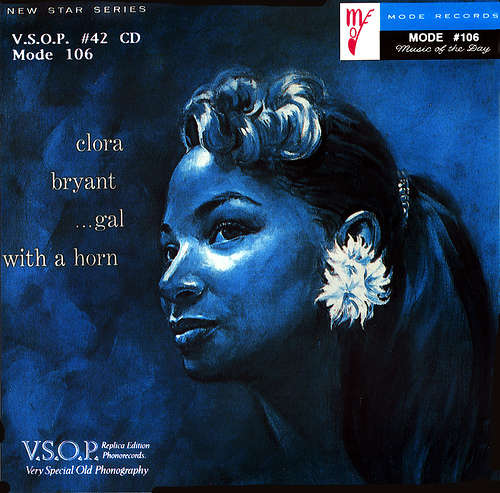
Strangely, in Dahl's interesting profile of Clora Bryant, one of the few sources of information on the singer/trumpeter currently available, no mention is made of Gal with a Horn (VSOP Records, 1995), a 1957 LP that Bryant cut for Mode Records and that constitutes the only entry in her CD discography to date. With a beautiful cover featuring a portrait of Bryant in black and blue, the album is a little too short at only eight tracks, "calculated to present Clora with tunes and setting that approximate her club performance," according to the original liner notes by Joe Quinn. Bryant sings and plays trumpet accompanied by Roger Fleming (piano), Ben Tucker (bass), and Bruz Freeman (drums), this quarter occasionally augmented by Walter Benton (tenor sax) and Normie Faye (trumpet). The program alternates between fast and slow numbers, all of them standards, showcasing the full range of Bryant's singing and playing and leaving ample room for solos.

The album kicks off with a swinging treatment of "Gypsy in My Soul" that allows her to play around with the melody for two full vocal choruses before closing her performance with an inventive, Gillespie-influenced solo. Her trumpet shines on a very relaxed reading of "Makin' Whoopee" graced by a very elegant piano solo by Fleming. This is followed by a lovely rendition of "Man with a Horn"("a natural for any trumpet playing entertainer," says Quinn) that Bryant makes entirely her own both vocally and instrumentally in one of the moodiest performances on the album. "Sweet Georgia Brown" is taken at a bouncy medium tempo that allows time for Bryant's trumpet plus a solo apiece from Benton and Fleming. The most unusual track on the LP is the Latin-flavored arrangement of Vincent Youmans's "Tea for Two" complete with a cha-cha-cha beat; it works because Bryant and everyone else involved are having a good time with it. Two tunes by Richard Rodgers and Lorenz Hart follow: Bryant reimagines the melody of "This Can't Be Love" ably aided by a lengthy piano solo by Fleming and then slows down the tempo for a wistful reading of "Little Girl Blue" that underscores the melancholy of the lyric and is embellished by a very soulful trumpet solo. Bryant again carries the weight of the group on the evergreen "S'posin'," which closes an excellent album that deserves to be better known from a very talented performer who deserves to be more than just a footnote in the history of jazz.

Clora Bryant and her trumpet