Thursday, November 17, 2011

The Session Man in New York: Dick Robertson's Hot Vocal Jazz Recordings of the 1930s


Dick Robertson is one of a group of singers that are often overlooked in most critical discussions of the history of vocal jazz and that, when mentioned at all, are usually dismissed as second-rate practitioners of the art. And yet, a great deal of the numerous records that Dick Robertson made between the mid-1920s and the early 1940s belie such a quick dismissal. Will Friedwald briefly mentions Robertson in his excellent book Jazz Singing in the same breath with Smith Ballew, Scrappy Lambert, and Chick Bullock, stating that he “was the most vaudevillian of this group, and often alternated between different voices . . . to suit the material” (52-53). It is true that some of Robertson’s recordings are novelty numbers that remind us of vaudeville, but Friedwald’s description of Robertson fails to capture the essence of his art, which rests on his ability to front small groups made up of excellent jazz musicians who shine in their own right besides providing support for his versatile voice. This is precisely what we find in the only compilation of Dick Robertson’s recordings, entitled The New York Session Man (Timeless Records, 1992), which concentrates on sessions that the singer led between March 1937 and September 1939.
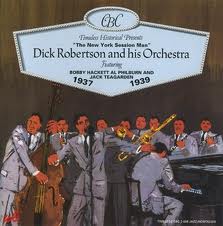

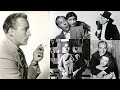
The title of this anthology is very appropriate. Dick Robertson was, indeed, a “session man,” a singer who gave up live performance for strictly studio work. Born in Canada, he had been singing professionally since the 1920s, mostly providing vocal refrains for various dance bands, when in 1935, Decca Records brought him into the studio to make a series of small-group jazz records. The company obviously trusted Robertson’s ear for choosing the best accompanists because they allowed him to handpick the lineup of his bands, and of course, his choices of sidemen do not disappoint, and his studio bands include some of the greatest jazz players of the 1920s and 1930s. On the twenty-four selections included in this compilation, we can hear the fabulous interplay between such illustrious names as cornetist Bobby Hackett, pianist Frank Signorelli (below, left), trombonist Al Philburn, guitarist Dave Barbour, drummer Stan King, and clarinetist Don Watt. Four sides waxed in February 1938 welcome the great Jack Teagarden on trombone into the studio group, and his hot playing enhances outstanding readings of tunes such as “Goodnight Angel” and “Let’s Sail to Dreamland.”


In accordance with the practice of the times, all of these sides range between a mid-tempo and an uptempo pace, and may be classified as primarily dance records. This is evident even in the case of numbers like “Gone with the Wind,” “Blossoms on Broadway,” and “I Only Want a Buddy, Not a Sweetheart,” which are usually treated as ballads but which are taken at a faster tempo by Robertson. The strong Dixieland feel of these discs must have sounded a little dated even when they were first released if we bear in mind that these platters hit the record stores coinciding with the advent of the Swing Era. However, they are recordings that have stood the test of time and that sound just as fresh now as when they were first made. And this is so not only because of Robertson’s knack for picking out magnificent sidemen but also because of his exciting vocal treatment of the lyrics. While it is true that novelty titles such as “The Merry-Go-Round Broke Down” and George Formby’s “Chinese Laundry Blues,” as Friedwald suggests, bring out the vaudevillian in Robertson, he manages to sound convincing when delivering more serious lyrics, as in the case of “It Looks Like Rain on Cherry Blossom Lane” and “Gone with the Wind,” to mention but two examples.

Another reason why a modern-day ear should still be interested in listening to these late-1930s recordings lies in the very engaging structure of the arrangements. Though Robertson is credited as the leader of the session, his voice is only another instrument and the vocal chorus that he performs is treated merely as yet another solo, which allows plenty of room for the sidemen to show off their talents. In this respect, Robertson’s Decca recordings are very similar to Billie Holiday’s classic Columbia sides with jazz greats like Lester Young and Teddy Wilson. Robertson’s studio bands sound relaxed and tightly knit, and the overall product leaves no doubt that the participants are having a good time trading inventive solos throughout.


A case in point is the lovely rendition of “Getting Some Fun out of Life,” a much-recorded number from the pen of Edgar Leslie and Joseph Burke. Frank Signorelli’s piano starts off the record with a few brief introductory bars, and then the whole ensemble states the melody, leaving a few more bars for Signorelli to put his signature on the tune before Robertson comes in with a very inspired vocal performance that swings easily while never straying a single note from the melody. After Robertson gets through singing the witty, well-constructed lyric, the remainder of the record is a pleasure to hear as Bobby Hackett (right), Johnny Carlson, and Don Watt trade hot solos, and, paraphrasing the lyric, the listener can bet they are getting some fun out of playing together.

As discographer Brian Rust observes in the liner notes to this compilation, Dick Robertson’s career as a recording artist came to an end following the infamous recording ban imposed by the American Musicians’ Union in 1942. By the time the ban ended, more than two years later, popular taste had shifted so much that there seemed to be no room for unabashedly hot jazz sides like these in the market, and as a result, Robertson did not make any more records. But fortunately, by the time he was forced into retirement, Robertson had already left behind an impressive body of work that shows that he deserves more credit than he receives these days. The twenty-four tracks on this Dutch compilation are ample proof of that and invariably leave the listener craving for more.

The great Jack Teagarden, whose hot trombone playing embellishes some of Dick Robertson's 1930s sides.

Works Cited

Friedwald, Will. Jazz Singing: America’s Great Voices from Bessie Smith to Bebop and Beyond. New York: Da Capo Press, 1996.

Rust, Brian. “Liner Notes to The New York Session Man 1937-1939.” Timeless Records, 1992.

Videos

WITHOUT THAT GAL (Posted on YouTube by edmundusrex)


NEVERTHELESS (Posted on YouTube by Bigband78)


IT’S THE TALK OF THE TOWN (Posted on YouTube by Bigband78)


I GOT RHYTHM (posted on YouTube by tmmvds)


HEY, YOUNG FELLA (Posted on YouTube by edmundusrex)


TWO CIGARETTES IN THE DARK (Posted on YouTube by MusicProf78)

Saturday, October 8, 2011

Buddy Clark: The Untimely Death of an Overlooked Crooner


After a ten-month hiatus, The Vintage Bandstand returns with a long-overdue article on Buddy Clark, one of my favorite singers of the 1940s, whose untimely death in a plane crash in 1949 cut short a career that was then at the peak of its commercial success.

On October 1, 1949, a plane crashed on Beverly Boulevard. It had been chartered by Buddy Clark so that he and some of his friends could attend a Stanford vs. Michigan college football game and be back in Los Angeles in time for Clark to host a radio show. The tragedy ended the career of one of the most popular singers of the 1940s at a point in time when his popularity was reaching its peak. Although lately Buddy Clark has not received as much critical recognition as some of his contemporaries, like Bing Crosby, Frank Sinatra, and Dick Haymes, he was one of the most successful vocalists of his time.


Born Samuel Goldberg in Dorchester, Massachusetts, in 1912, Clark was first drawn to sports but would soon take up music as a profession, singing on popular radio shows such as Your Hit Parade and Let’s Dance, the latter starring Benny Goodman and his orchestra. Like many other singers of the era, Clark was primarily influenced by the warm sound of Bing Crosby, which can be heard particularly in his early, lesser-known sides for Vocalion. Crosby’s influence aside, in time Clark would develop into a very recognizable singer, with a distinctly smooth and romantic approach to the vocal art that earned him quite a following. As Roy Hemming and David Hajdu noted, in the years when younger listeners favored Frank Sinatra’s intensely intimate style, Clark’s rich baritone appealed to “the middle-of-the-road listener who favored a more straightforward style of pop singing” (104). This style can be heard at its best in some of Clark’s recordings of the 1940s, particularly when he decided to revive older songs such as “That Old Gang of Mine,” “I’ll See You in My Dreams,” and “I’ll Get By,” the latter recorded by Bing Crosby as early as 1928.


Though Clark was constantly heard singing live on radio and making radio transcriptions in the late 1930s and early 1940s, his career as a recording artist would not come into its own until 1946, when he was the featured vocalist with the Ray Noble orchestra on “Linda,” a Columbia recording that became an instant success and marked the beginning of a series of hits that was only cut short by his death a couple of years later. “Linda” is more of a skit than a song and includes some spoken sections: the lyrics present Clark’s character trying to talk a girl, Linda, on whom he has been keeping an eye for days, into accepting to go out on a date with him. The first three lines are memorable in their depiction of Clark’s light-hearted obsession with Linda:

When I go to sleep
I never count sheep
I count all the charms about Linda


Of course, as the song advances, Clark’s smooth crooning succeeds in breaking down the girl’s reticence and securing the date for Saturday night: “Boy, that’s a date!” says a delighted Clark toward the end of the song. With its very catchy tune, “Linda” topped the Billboard charts in 1947 and was so successful that about a year later Clark and Noble came up with a follow-up entitled “I’ll Dance at Your Wedding,” which did not achieve the same kind of success as its predecessor but which is also a very enjoyable recording.


Promotional movie short starring Buddy Clark that dramatizes the story told in the lyrics to "Linda" (posted on YouTube by neverknewtillnow)

After “Linda” hit the charts, Clark’s days as a vocalist on radio transcriptions that mostly used stock arrangements and on which he was often uncredited and backed by bands led by Freddy Martin, Eddy Duchin, and Benny Goodman, among others, were over. Hit recordings started pouring in, great sides like “How Are Things in Glocca Morra?,” Cole Porter’s “You’d Be So Nice to Come Home to,” and his revival of “Peg o’My Heart,” which have not received as much critical attention as their musical quality should have warranted. The last two years of Buddy Clark’s life were also filled with healthy record sales and chart hits, including a duet with Doris Day on “My Darling, My Darling” and another with Dinah Shore on the classic “Baby, It’s Cold Outside.” Shortly before his tragic death in the fall of 1949, Clark had taken to the stage in a production of the George and Ira Gershwin musical Girl Crazy, which could have in time opened the doors to Broadway. However, he would not have the opportunity to make it big on the stage, and the plane crash that claimed his life thwarted the wonderful career of a man who had certainly worked hard to achieve the success that he was finally enjoying.

Buddy Clark with arranger/conductor Mitchell Ayres

Unfortunately, not a lot Buddy Clark’s recorded output is readily available on CD, which could very well explain the neglect into which he has fallen as of late. Many fine compilations, such as Here’s to Romance (ASV Living Era) and Remembering Buddy Clark (Collector’s Choice), are out of print, and reissues of his 1930s recordings (Take Two’s Band Vocals from the Thirties, for instance) have also been discontinued. Therefore, the best and most affordable option available is the aptly entitled Linda, a collection released by Collectables Records featuring twenty-four of his recordings made between 1942 and 1949, ranging from a version of the novelty tune “K-K-K-Katy” with organ accompaniment to the delightful “A Dreamer’s Holiday,” his last chart entry, recorded in September of 1949. In between, there are a host of magnificent recordings that showcase Clark’s polished singing style, as well as his collaborations with arranger/conductor Mitchell Ayres, who directs the orchestra on Clark’s renditions of “It’s a Big, Wide, Wonderful World,” Bing Crosby’s perennial “Just One More Chance,” “If This Isn’t Love,” and “An Apple Blossom Wedding,” to name but a few.


The compilation also includes Clark’s very enjoyable take on Edith Piaf’s “La Vie en Rose,” with an English lyric by Mack David entitled “You’re Too Dangerous Cherie,” as well as three Latin-flavored sides from 1946-1947 (“South America, Take It Away!,” “Chiquita Banana,” and “You Don’t Have to Know the Language”) on which he is accompanied by the great Xavier Cugat orchestra, proving his undeniable versatility and ease with novelty songs. The overall sound of the compilation is good, and the liner notes by Mark Marymont, albeit rather short, are quite informative. However, Buddy Clark’s recorded legacy deserves a more thorough CD reissue encompassing both the 1930s and 1940s that may help put his career into perspective and contribute to granting him the recognition that he deserves.

Works Cited

Roy Hemming and David Hajdu. Discovering Great Singers of Classic Pop. New York: New Market Press, 1991.

Mark Marymont. "Liner Notes to Linda." Collectables Records, 1999.

Videos

TEN O'CLOCK JUMP - with Eddy Duchin (posted on YouTube by knarf826)


POWDER YOUR FACE WITH SUNSHINE - with Doris Day (posted on YouTube by Dayniac4324)


PEG O'MY HEART (posted on YouTube by rhymebaron)


GIRL OF MY DREAMS (posted on YouTube by terracite)


A DREAMER'S HOLIDAY (posted on YouTube by philsmusic1000)

Sunday, December 12, 2010

Jim Godbolt and Thirty Years of Jazz in Britain, 1919-1950


The Book: A History of Jazz in Britain

In 2005, Northway Publications brought out the second edition of Jim Godbolt’s A History of Jazz in Britain, one of the most informative and most thoroughly researched books on the jazz activity that took place in Great Britain from the early 1920s to the early 1950s. Originally published by Quartet Books in 1984, the volume is not exactly a history of jazz in Britain but rather a chronicle of the different ways in which jazz was received in the British Isles. In an effort to explore how the English public reacted to the coming of jazz, Godbolt draws heavily on contemporary newspaper articles and record reviews and features that appeared in specialized jazz periodicals such as the Melody Maker, Rhythm, Swing Music, and Hot News, noting that journalism and research on jazz were noticeably more prolific in Britain and the rest of Europe than in the United States in these early years.

Godbolt opens his book around 1919, coinciding with the pioneering visit to England of the Original Dixieland Jazz band, the first jazz orchestra to appear and record in the Old World, and brings it to a close in the early 1950s, when the British jazz scene was in the midst of a stylistic battle between the supporters of traditional, New Orleans-style jazz and the followers of modern bebop. Godbolt eloquently justifies the scope chosen for his work in the introduction:

I had two main reasons for not taking this summary beyond 1950. An attempt to embrace events from 1919 to the present day . . . was so daunting a notion that I gave it no more than a cursory thought . . . The second reason is that from 1950 the scene was so different from that of the preceding years. The big bands were to collapse; there were to be the coincident phenomena of ‘trad’ and ‘bop’ and then ‘mainstream,’ where many of the stylistic opposites came to join hands. (xii)

The Original Dixieland Jazz Band, the first jazz band to play in Great Britain

The closing chapter does deal with the years after 1950, but the author consciously chooses not to delve into those events, well aware that the subject matter would deserve another full-length volume.


From the previous quotation, it becomes apparent that the history of jazz in Britain was one of opposites and stark contrasts: first of all, there was the opposition between those critics who embraced and celebrated jazz and those who openly criticized it; then there was the important distinction between the dance bands that performed sweet, commercial dance music and that only seldom featured jazz and the exclusively jazz-oriented hot combinations in the twenties and thirties; finally, when jazz had completely taken hold in Britain, there arose the heated debate between the followers of traditional jazz and those of modern bebop. Amid the excitement created by the new sound and the visits of great American stars by the likes of Louis Armstrong and Duke Ellington in the 1930s, critics attempted to establish some criteria for the evaluation and criticism of jazz performances and records. Godbolt notes that in its early years, since its inception in January 1926, the Melody Maker was “as confused and convoluted in its critical judgments about jazz as the variety journals and national newspapers” (18).


Nevertheless, criteria and some kind of critical consistency were gradually attained as more and more records by both American and British bands were released in England, in many cases with a delay of several years. Slowly, jazz began to penetrate British life, and a solid base of avid fans and record collectors was established, many of them gathering in local Rhythm Clubs to enjoy live performances and record recitals and often sharing their views on the music via newsletters and similar publications. Godbolt also devotes a whole chapter to the pioneering jazz discographers, that is, the meticulous researchers who sought to set in writing the personnels of every jazz session ever committed to wax. The author notes that the figure of the discographer is, at least in these early years, essentially European, and he praises the dedication of researchers such as Brian Rust, Ralph Venables, Albert McCarthy, and Dave Carey for their invaluable contributions to early jazz scholarship.

Of course, Godbolt devotes numerous pages to assessing the artistry of the many native British jazz combinations that sprang up inspired by the new sound coming from America: as the records by Spike Hughes, Nat Gonella, Harry Parry, and Humphrey Lyttelton clearly show, British musicians were prompt to ably assimilate the new idiom, and a series of respected sidemen emerged, including Johnny Dankworth, Buddy Featherstonhaugh, Hugo Rignold, and Vic Lewis, many of whom were at one time employed by commercial dance bands with little or no interest in jazz. Many of these British combos often employed the services of American musicians visiting the country. One of these was arranger and multi-instrumentalist Benny Carter, who was hired by Henry Hall to write the arrangements for the BBC Dance Orchestra but who was not allowed much room to indulge in jazz during his tenure with the orchestra. This flow of American musicians working in Britain would soon come to an end, though, as ongoing disputes between the British and American musicians’ unions resulted in an infamous ban preventing American jazzmen from appearing in public or recording on British soil that lasted for well over two decades. As a matter of fact, one of the most interesting–and outrageous–chapters in Godbolt’s book relates the ridiculous lengths to which some promoters had to go in post-WWII England to bend the law just enough to have jazz giants Sidney Bechet and Coleman Hawkins perform in Britain, sometimes even facing legal prosecution.

British jazzman and pioneering critic Spike Hughes

Written by someone who lived through these exciting years and who was a part of the history of British jazz as manager, promoter, and music critic, Jim Godbolt’s A History of Jazz in Britain is highly readable, extremely enlightening, and definitely an essential work for anyone interested in the reception of jazz in Europe in general, and in Great Britain in particular.


The Box Set: Jazz in Britain 1919-1950

Coinciding with the reissue of Godbolt’s book, and meant as a companion volume, in 2005 Proper Records released a four-CD box set entitled Jazz in Britain 1919-1950. Featuring a very interesting booklet illustrated with a good number of photographs, the set is annotated by Godbolt himself and is therefore intended as a sort of soundtrack to the book, although understandably not all the records mentioned in Godbolt’s work are included in the box set. For his liner notes, Godbolt draws largely on material from the book, offering a great deal of information that undeniably enriches the listener’s appreciation of each track. The title of the box set may be somewhat misleading at first sight: though it reads “Jazz in Britain,” not all the cuts showcase British bands and not all of them were made on British soil. Whenever possible, sides by American musicians waxed in the British Isles have been included, yet if a specific band or artist never got around to making any records in Great Britain, Godbolt’s policy has been to present recordings made around the time of that act’s tour of the country in order to give the listener an idea of the kind of material that British audiences would have heard. Moreover, because of the breadth of the subject matter, there are omissions in the compilation–which Godbolt acknowledges in his notes–but overall the collection is a very satisfying musical introduction to jazz in Britain in the first half of the twentieth century.


Godbolt chooses to present the tracks in chronological order, which proves to be the correct choice as it “[gives] the listener every indication of the changes in fashion, style, and execution that took place over thirty years” (6). Thus, the compilation starts off with the Original Dixieland Jazz Band’s landmark recording of “At the Jazz Band Ball,” made in London in 1919 during the band’s first visit to the United Kingdom, and it goes on to offer a host of fine cuts from British and American sweet and hot combinations made between the twenties and the forties, leading up to the years in which bop took hold in the British Isles and divided jazz fans and practitioners alike into two fiercely opposed factions. In between, there are excellent offerings from homegrown bands including legendary musicians such as Nat Gonella, Buddy Featherstonhaugh, Johnny Dankworth, Humphrey Lyttelton, Danny Polo, Spike Hughes, and Freddy Gardner, to name but a few. In addition, the tracks by American jazzmen who visited the Old World, like Duke Ellington, Louis Armstrong, Sidney Bechet, Art Tatum, Fats Waller, Cab Calloway, Benny Carter, and others, give us an idea of the kind of material that influenced their British counterparts. The compilation also pays tribute to the extremely popular British dance bands of the 1920s and 1930s, some of which housed among their ranks some of the most gifted musicians of the era, who often graced the records of orchestras led by legendary bandleaders such as Jack Hylton, Ambrose, Ray Noble, and Fred Elizalde with their hot solos. In Godbolt’s insightful words,

It was one of the ironies of this saga. Those dance bands were despised and derided by purist jazz enthusiasts, but it was in this milieu of cloying and corny arrangements and some ghastly period vocals that certain musicians prevailed upon their frock-coated, baton-waving, forever-beaming bandleaders to be allowed the occasional chorus and special arrangement of a jazz standard. (7)

Autographed publicity photo of British bandleader Jack Hylton

All in all, this is a highly recommendable collection: indeed, it is not often that we find so well rounded a compilation serving as the perfect soundtrack to illustrate a finely written book. Proper Records’ Jazz in Britain 1919-1950 is a magnificent survey of the different strains of jazz that were being performed and heard in the British Isles over the thirty-year period that it covers. Full of lesser-known musical gems, the box set never fails to surprise and is absolutely priceless as a companion to Jim Godbolt’s indispensable study A History of Jazz in Britain.

Works Cited

Jim Godbolt. A History of Jazz in Britain 1919-50. London: Quartet Books, 1984.

Jim Godbolt. “Liner Notes to Jazz in Britain 1919-1950." Proper Records, 2005.

Videos

NAT GONELLA


JACK HYLTON - LIFE IS JUST A BOWL OF CHERRIES


HUMPHREY LYTTELTON - BAD PENNY BLUES


DANNY POLO - CHINA BOY


CLEO LAINE & JOHNNY DANKWORTH - OH, LADY BE GOOD!


HARRY PARRY - I CAN'T DANCE

Thursday, September 30, 2010

The World’s Greatest Entertainer in His Prime: Al Jolson on Columbia 1913-1932


When in 1927 Al Jolson stood in front of the camera and proclaimed, “You ain’t heard nothin’ yet!” he was using the phrase to refer to the much-publicized novelty of the movie in which he was starring, The Jazz Singer, now widely considered the first talking picture of all time even though it was actually just a part-talkie, that is, a silent film interspersed with a few sound scenes. Jolson’s utterance may have applied to the movie, yet it most certainly did not apply to Jolson himself: the public had heard quite a bit from Jolson by 1927, which was the reason why he had been selected to play the leading role in a film whose script, by Samson Raphaelson, strangely echoed Jolson’s own life story. In fact, it was virtually impossible to be interested in pop music in the 1910s and 20s and not have heard of Jolson, the bombastic vocalist who billed himself as “the world’s greatest entertainer” and had become the most popular singing sensation in the country.


Despite the title of that groundbreaking film, though, Jolson never was strictly a jazz singer: he could be more accurately described as a pop singer whose work was occasionally tinged by the jazz idiom and who knew how to use jazz syncopation to his advantage, thereby creating a very appealing dramatic effect. Of course, drama featured prominently in Jolson’s approach to the vocal art: in the days prior to the invention of the microphone, his impressive, energetic voice could effortlessly fill any theater, and it sounded equally exciting on his signature sentimental mammy songs as it did on the most jazz-influenced of his rhythm numbers. His stage show brimmed with emotion and unrestrained energy, and both his antics and his exuberant vocal style influenced just about everyone in show business, at least until Bing Crosby came along in the early 1930s and showed the world that there was an alternative, more intimate approach to popular singing. But by then, the microphone had already entered the picture, changing the face of popular music forever. The new style heralded by Crosby sent some of the earlier singers, who now sounded desperately old-fashioned, out of business, yet Jolson still enjoyed quite a following on radio and movies throughout the 1930s, making no efforts to modify his style to suit the new technical advancements. The release of the excellent biopic The Jolson Story in 1946, starring Larry Parks and William Demarest (as well as the inferior but equally charming sequel Jolson Sings Again, from three years later) revived interest in Jolson’s music, as a whole new generation of listeners were exposed to his sound via the re-recordings of his old hits that he made for Decca.


These newer, updated versions of Jolson’s songs, often with markedly different arrangements and instrumentation, are nowadays the best-known and more widely available of his recordings. However, this volume of Columbia’s Art Deco Series, originally published in 1994 and currently out of print, digs deep into Jolson’s vast recorded legacy and presents some of his best sides cut for the label between 1913 and 1932, when Jolson was truly at the top of his game, complete with very detailed liner notes by Herbert G. Goldman and Will Friedwald. Made acoustically before the microphone allowed electricity to be used for recording sound, these cuts lack the higher fidelity of the later Deccas, yet they are clear evidence as to why Jolson reigned over the pop music world of the period. It is true that the arrangements are often dull and are performed by studio orchestras that cannot match the excitement always present in Jolson’s voice, but these sides chronicle his development as a recording artist and make for an extraordinarily enjoyable listening experience even almost a century after some of them were made.


The collection opens with Jolson’s 1913 rendition of “That Little German Band,” going back to the earliest days of his tenure with Columbia, and includes songs that he introduced and with which he became closely associated, such as “Yaaka Hula Hickey Dula,” “Swanee,” “Avalon,” “April Showers,” and “Toot, Toot, Tootsie! (Goo’Bye).” Jolson would re-record many of them later on in his career, but these are the earliest versions, and in many cases, the definitive ones. On some of the tracks, Jolson proves that he can also put across more sentimental ballads quite convincingly: as “Back to the Carolina You Love,” “Down Where the Swanee River Flows,” and “In Sweet September” demonstrate, Jolson was much more than simply a belter of lively rhythm numbers and maudlin mammy songs, a fact that is also evident in his excellent recording of “The Anniversary Song” for Decca in the 1940s. And of course, he is at his high-spirited best on novelty songs like “O-Hi-O (O-My!-Oh!) and “Where Did Robinson Crusoe Go with Friday on Saturday Night,” full of the witty double entendre lyrics that he always delivered so masterfully. (Incidentally, “Robinson Crusoe” spawned a very interesting western swing version by Texas Jim Lewis.)


In early 1924, Jolson ended his contract with Columbia and signed with Brunswick, which explains why the songs that he cut for the soundtrack of The Jazz Singer are not included here. However, the compilation closes very fittingly with three sides that Jolson made in 1932 for the American Recording Corporation backed by Guy Lombardo and His Royal Canadians: “Hallelujah I’m a Bum,” the title track of his then-current (and very interesting) movie; “You Are Too Beautiful,” a superb ballad that has since become a standard but that Jolson does not deliver as convincingly as other slow numbers in this collection; and a remake of his classic “Rock-a-Bye Your Baby with a Dixie Melody.” These are the only recordings included here made electrically, and they certainly capture Jolson’s voice much better, showing how much he had evolved as an entertainer since the 1913 records that kick off the set: he is now a singer in complete control of his art, and he knows exactly how to accentuate those elements and mannerisms that make his style unique.

After this date with Lombardo, Jolson would not set foot in a recording studio until the mid-1940s, although he would still be a regular fixture on radio. For those of us who were not fortunate enough to attend one of Jolson’s live performances, it is difficult to imagine just how exciting his stage show must have been: indeed, his records, movies, and radio appearances stand as faint documents of his idiosyncratic art, and contemporary journalistic accounts and reviews of his shows inevitably fail to convey the exuberance of his stage persona. Like Jacques Brel after him, Al Jolson was an artist that needed to be experienced in a live setting, yet we must be grateful that at least some of this excitement has been preserved for posterity on recordings like the ones that make up this excellent compilation.

Videos

TOOT, TOOT, TOOTSIE! (GOO'BYE!)


BLUE SKIES


APRIL SHOWERS


MY MAMMY


I'M SITTIN' ON TOP OF THE WORLD


SWANEE


AVALON

Wednesday, July 7, 2010

Hot, Lovable, and Sweet: Annette Hanshaw and Early Female Vocal Jazz


Annette Hanshaw was one of the very first female jazz vocalists, as well as one of the most exciting singers of the 1920s and early 30s. Critic Will Friedwald, who has written extensively (and most insightfully) on jazz singing, ranks her alongside Al Bowlly as one of the few artists that “used the musical idiom of the twenties in a creative, modern way” (1). Although I believe that there were more singers other than these two that also experimented with more modern approaches to the vocal art in that era, Friedwald is certainly right concerning Hanshaw: she was well ahead of her time in that she understood the rhythmic qualities of jazz much better than most of her contemporaries and applied them to her singing in a very personal, highly inventive way. From today’s standpoint, there is no doubt that her records sound more modern and engaging than those of Helen Kane or Ruth Etting.

Born into a wealthy family in 1901 (although for many years the date was believed to be 1910), Hanshaw got her start performing at her father’s hotels. On a certain night in 1926, producer Herman “Wally” Rose (whom she would later marry) happened to be among the audience and was quick to realize her potential, subsequently signing her to a contract with Pathé. These were the years of the recording boom, when large amounts of records were produced and sold worldwide, and so Hanshaw recorded extensively, soon becoming one of the most popular artists on the label and gaining more public exposure through a series of radio spots. It did not take her long to graduate to one of the major labels, Columbia, who also put out the records of Ruth Etting, at the time one of the most popular singing stars in the country. Columbia issued Hanshaw’s efforts on subsidiary budget labels in order to prevent any kind of conflict between the two singers, but this did not affect her record sales, and even in the years following the 1929 stock market crash, Hanshaw still proved to be extremely popular with record buyers.


But despite the success of her records, Hanshaw apparently dreaded public appearances and did not exploit her image as the quintessential 1920s flapper in movies. After her marriage to Rose in 1934, she decided to put an end to her very popular radio show and stopped recording altogether around 1938. Hanshaw would live to see her records reissued in the 1970s, when she was certainly surprised to find out that there was a kind of renewed interest in her recorded output. Unfortunately, unlike other stars from the twenties such as Nick Lucas, she never really attempted to make a comeback. Her husband had passed away in 1954, and in 1975 she remarried; nobody seems to have advised her that it would have been a good idea to get back into the recording studio, and if anyone did, she did not listen. Hanshaw died in New York in 1985, leaving behind a very valuable legacy of recorded music that is highly interesting to both pop and jazz aficionados.

Her complete recordings are yet to be reissued in their entirety (a project that, like the release of Cliff Edwards’s Hot Combinations, should be undertaken by some label like Proper or JSP), but there are a couple of fine compilations on CD that serve as good introductions to her music. Lovable & Sweet (ASV / Living Era, 1997) is perhaps the best one around, and although the English reissue label seems to have gone out of business, the disc is still fairly easy to find. The material included in the collection proves, on the one hand, that Hanshaw very adeptly assimilated the jazz idiom very early on, and on the other, that her selection of material is very wide-ranging. She sings rather straight on two Hawaiian-flavored sides with Frank Ferera (“Pagan Love Song” and “Ua Like No a Like,” from 1929) but she applies her jazz inflections not only to jazz numbers like “Black Bottom” and “Six Feet of Papa,” but also to more conventional pop tunes such as “Little White Lies” and “Walkin’ My Baby Back Home.” When she runs through “Everything’s Made for Love” (1926), with Irving Brodsky on piano, she sounds way hipper than crooner Gene Austin in his version of the tune recorded that same year. Two of my personal favorites on this compilation, which features tracks waxed between 1926 and 1934, are her outstanding 1930 rendition of “Body and Soul” (which even includes an accordion) and her 1934 recording of Harold Arlen and Ted Koehler’s “Let’s Fall in Love,” in which she is backed by an all-star band including Jack Teagarden and Joe Venuti.


As a matter of fact, many of her hot sides included such jazz luminaries as Tommy and Jimmy Dorsey, Benny Goodman, Eddie Lang, Red Nichols, Miff Mole, Manny Klein, and Adrian Rollini. These are well represented in The Twenties Sweetheart (Jasmine, 1995), a compilation that concentrates on Hanshaw’s earlier recordings, cut between 1926 and 1928. Here, Hanshaw’s vocals are at their jazziest best, bouncing along effortlessly, her voice shining atop the hot backings: these are the records that built her reputation as a jazz singer, and many of them end with her idiosyncratic “That’s all!,” used to mark the end of the record right after the last note has been played. As her records clearly show, Annette Hanshaw is an essential figure of the early stages of recorded vocal jazz. It is too bad that she decided to cut short her remarkable career, that she chose not to make any more records. But the records that she made are certainly jazz classics and prove as enjoyable more than eighty years after they were cut as when they were first released. In my opinion, no assessment of Hanshaw’s stature as an artist is more accurate than that of John Hammond, who is reported to have said about her, “I don’t think she realizes how good she is” (2). Fortunately, any jazz fan easily does.

Notes

(1) Will Friedwald. Jazz Singing. New York: Da Capo Press, 1996: page 59.

(2) Jazz Singing, page 62.


Videos

WE JUST COULDN'T SAY GOODBYE


HERE OR THERE


BODY AND SOUL


LET'S FALL IN LOVE


BLACK BOTTOM


DON'T TAKE THAT BLACK BOTTOM AWAY