Showing posts with label Tommy Dorsey. Show all posts

Friday, May 15, 2015

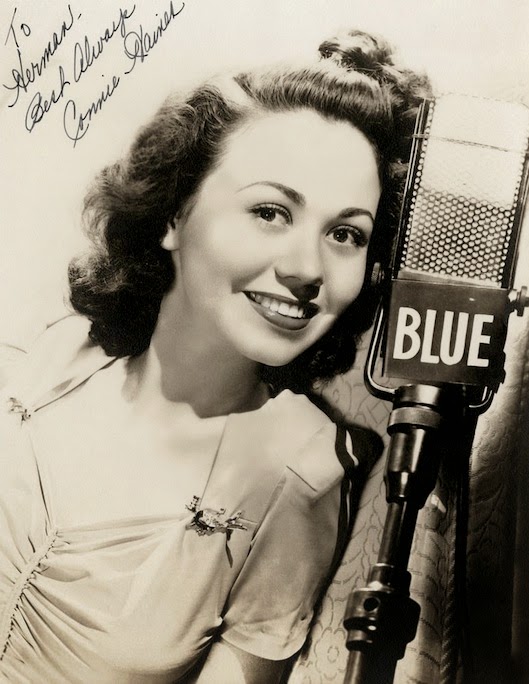
Connie Haines, A Nightingale with a Southern Accent

A fantastic 2008 release from the British label Sepia Records works well as an excuse to take a look at the career of Connie Haines, one of the most swinging and most exciting female singers of the Swing Era, who is unfortunately not as well remembered as other contemporaries such as Peggy Lee, Jo Stafford, and Helen Forrest.

If ever there was a band singer who devoted most of her life to showbusiness, that was Connie Haines. Born in Savannah, Georgia, in 1921, her whole name, Yvonne Marie Antoinette JaMais, was too long and not very commercial, so when she joined the Harry James orchestra, the trumpeter asked her to change it. But Haines could be found singing over the airwaves well before that, and by the age of ten she already had her own radio show in Jacksonville, Florida, since her family had moved to the Sunshine State. At that early stage of her career she was billed as "The Little Princess of the Air," and although her charming southern accent would have certainly qualified her for performing western swing or country music, she preferred to stick with swing and pop. After moving to New York, where she was appearing at the Roxy Theater by the time she was fourteen, Haines began to make the rounds of the nightclubs there, which would ultimately lead her to join the Harry James band in 1939, at the time still a struggling outfit trying to make headway in the big band business.

Connie Haines and Frank Sinatra
It was precisely at this time that Haines first crossed paths with Frank Sinatra, who had also been discovered by James and was still beginning to develop his distinctive style. The careers of Haines and Sinatra would remain intertwined for at least a couple of years, because one year later, both singers would be hired away by Tommy Dorsey, who led one of the most successful and jazz-infused orchestras in the country. The trombonist also had one of the most inventive arrangers of the period in Sy Oliver, and realizing the selling potential of singers, he was starting to feature his vocalists more prominently on his records, giving them more than just brief refrains to sing and building whole arrangements around them. Besides Haines and Sinatra, Dorsey also employed Jo Stafford and the vocal group The Pied Pipers, and all of them appear in classic recordings such as "Snooty Little Cutie," "Oh, Look at Me Now," and "Let's Get Away from It All." On the latter we can hear Sinatra poking fun at Haines's southern accent: when the lyrics call for her to sing the line, "I'll get a real southern drawl," Sinatra jokingly replies in feigned amazement, "Another one?" In his book Sinatra: The Song Is You, Will Friedwald mentions that, according to Haines, she and Sinatra did not get along, but if that is true, it does not come across in their records together, which are always a lot of fun to listen to. Dorsey also had the good judgment to feature Haines on her own on several fine numbers, such as Cole Porter's "What Is This Thing Called Love?" and Matt Dennis and Tom Adair's "Will You Still Be Mine?" but by 1942 she had decided to follow the example of Young Blue Eyes and launched a solo career.

Haines always credited Dorsey with teaching her how to phrase—another thing that she and Sinatra had in common—and by the time she left the band, she had grown quite a bit as a singer and was ready to strike out on her own. Another important influence was torch singer Helen Morgan, to whom she would dedicate a whole album entitled Connie Haines Sings a Tribute to Helen Morgan in 1957. As a solo attraction, Haines performed on radio on the Abbott & Costello Show, and in the 1950s she appeared regularly on television, on such popular programs as the ones hosted by Ed Sullivan, Milton Berle, and particularly on the Frankie Laine Show. She was also featured in a few now-forgotten musicals, including Robert Z. Leonard's Duchess of Idaho (1950), alongside Van Johnson and Esther Williams. Haines recorded steadily for both major and smaller labels (Capitol, Mercury, Columbia, Signature, and Coral are just a few examples) and although she became primarily known for novelty numbers, her discography includes everything from ballads to torch songs to country-tinged material, and in tandem with Jane Russell, Rhonda Fleming, and Beryl Davis, she even delved into gospel and sacred territory. What is more, though her recording activity had decreased by the 1960s, she still found time to cut a few Smokey Robinson songs for Motown, of all labels. Songs like "Midnight Johnny" and "What's Easy for Two" are a big departure from her usual style, but they are definite proof of her willingness to adapt to changing tastes in popular music. Despite having to battle cancer in her later years, Haines kept performing for live audiences off and on until the 1990s, and she died at 87 in Clearwater Beach, Florida, in 2008.

While her sides with Tommy Dorsey are fairly easy to find on CD, the Sepia release Nightingale from Savannah draws from her post-Dorsey years, featuring 27 tracks she recorded between 1946 and 1953 for Mercury, Signature, and Coral. It seems clear that these labels were trying to sell her mainly as a sprightly novelty vocalist, as titles such as the 1949 hits "You Told a Lie" and "How It Lies, How It Lies, How It Lies" suggest. Other novelty tunes she cut around this time are "Shoo-Fly Pie and Apple Pan Dowdy" (a hit for Dinah Shore), "Let's Choo Choo Choo to Idaho," and "A Bushel and a Peck," among many others. Like her hit, "How It Lies," many of her recordings have a certain country flavor to them, as is the case "Too Many Hearts" and "You Nearly Lose Your Mind," the latter a bluesy pop version of an Ernest Tubb country classic.

But Haines also felt comfortable singing ballads and torch songs—we must not forget the Helen Morgan influence—and even though she does not quite reach the depths of pathos and despair of a Billie Holiday or a Lena Horne, she turns out respectable readings of "My Man" and "Stormy Weather," sounds really believable on the old chestnut "You Made Me Love You," and on "Lover Man" and "The Man I Love" she proves that she can also handle a small-group jazz setting with ease. Her 1947 remake of her Dorsey hit "Will You Still Be Mine?" with the Ray Bloch orchestra includes updated special lyrics that mention, among other celebrities, Sinatra, FDR, Bing Crosby, Vaughn Monroe, Walter Winchell, and J. Edgar Hoover! Her version of the Teresa Brewer song, "Ol' Man Mose," prefigures her later gospel-inflected recordings, and among the highlights of the collection are her duets with Alan Dale on the Dixieland-ish "The Darktown Strutter's Ball" and her old friend Bob Crosby on "Destination Moon" and "What Have You Done for Me Lately?" Listening to this Sepia compilation, it becomes clear that Connie Haines is an unjustly overlooked figure of the Swing Era, a versatile vocalist with a subtle, charming southern drawl who deserves to be rediscovered.

Other Selected CDs by Connie Haines

In spite of its awful cover, Kiss the Boys Goodbye (Bygone Days Records) features several of Connie Haines's recordings with Tommy Dorsey (both as the single spotlighted vocalist and with Sinatra, Stafford and the Pipers), as well as a good sample of her post-Dorsey sides. The aforementioned Connie Haines Sings a Tribute to Helen Morgan (Pickwick Records) is a worthwhile addition to any serious Haines collection, while The Heart and Soul of Connie (Audiophile Records) includes sides from 1950 and 1951 on which she is backed by the Russ Case orchestra. Finally, Feel the Spirit (Jasmine Records) presents her sacred recordings with Jane Russell, Rhonda Fleming, and Beryl Davis.

Connie Haines with the Tommy Dorsey Orchestra

Thursday, July 18, 2013

Unsung Vocalists of the Past 1: Seger Ellis

We begin a new series of articles, spotlighting singers whose popularity has faded over the years and who, for different reasons, have unjustly fallen into obscurity. With the help of a very interesting CD released by The Old Masters and entitled Jazz in a Sentimental Mood, the first entry in the series is devoted to the lesser-known but great Houston-born vocalist/songwriter/pianist Seger Ellis.

At the outset of his career, Seger Ellis did not really want to be a singer. Rather, his main interest lay in writing songs and playing the piano, and it was indeed as a pianist with the now forgotten Lloyd Finlay Orchestra that he made his first recordings in 1925 in his native Houston for Victor. In addition to the sides he cut as part of the Finlay band, Ellis was asked to make some piano solo recordings, which were never issued due to technical difficulties during the recording process. However, Ellis would soon be summoned to Camden, New Jersey, by the label to wax his piano solos again, this time using the then newly introduced electrical recording method, and upon their release, these records were sufficiently well received by the public to persuade Ellis to launch a professional career as a recording artist in New York City. Incidentally, these early piano solos, most of which were written by Ellis himself, can be found in the excellent CD Black and White Piano, Volume 1 (Document Records, 1998), a highly recommendable collection that also includes cuts by Clarence M. James, Sidney Williams, and Lovin' Sam Theard, among other obscure 1920s pianists.

It should be noted that Ellis' intention at this stage was still to sell himself as a pianist, not as a singer. This would soon change, though, when he was encouraged by the small radio station on which he was appearing to sing as well as playing piano over the air. Thus, after his move to New York, when he made his first recordings for Columbia, the company decided to promote him as a crooner, marketing his records to rival those of Gene Austin, who was one of the foremost vocalists of the late 1920s, with smash hits such as "My Blue Heaven," "I've Got a Feeling I'm Falling," and "Five Foot Two, Eyes of Blue." Columbia's marketing efforts most likely explain why Ellis' voice sounds so high-pitched on his Columbia and Okeh records: this was a conscious attempt to make Ellis sound like other popular crooners of the era, such as Austin, Nick Lucas, Johnny Marvin, and Little Jack Little. In his excellent liner notes for the CD Jazz in a Sentimental Mood, Allan Dodge hints at the fact that Ellis was not thrilled by the sound of his voice on these sides, but he kept cultivating that style in view of the success of the records.

One of the attractions of Ellis' recorded output for Columbia and Okeh lies in the amazing personnel that accompanied him on most of the sessions, featuring some of New York's most prominent jazz musicians of the time. It appears that Ellis was granted the power to choose the members of the studio band for his recordings, and if that is the case, he certainly had a keen ear for good jazz, since he was often backed by highly accomplished musicians like Tommy and Jimmy Dorsey, Eddie Lang, Joe Venuti, Rube Bloom, Manny Klein, Hoagy Carmichael, and Muggsy Spanier, many of whom would go on to greater things during the Swing Era and beyond. Ellis himself played piano on some of the dates, and Eddie Lang's guitar is heavily featured on most of these very inspired arrangements, which are often quite adventurous, as in the case of Ellis' 1928 version of "Where the Shy Little Violets Grow," with an interesting steel guitar solo by Andy Sannella. In August of 1929, Ellis' studio band even included Louis Armstrong, who was then making his legendary series of hot five and seven recordings, on trumpet, and their reading of "Ain't Misbehavin'" remains one of Ellis' most enduring recordings.

At the time of this writing, there is only one full-length CD devoted to the music of Seger Ellis: Jazz in a Sentimental Mood, produced by the reissue label The Old Masters. Its title accurately encapsulates the defining elements of Ellis' style: his recordings are often sentimental, characterized by his high-pitched voice and relaxed singing style, but there is an undeniable hotness to them, and they are full of jazzy solos by some of the most important jazz instrumentalists of the period. In my opinion, the jazzy quality of the arrangements is precisely what differentiates Ellis' recordings from those of Gene Austin, whose accompaniments were not always comparatively as jazz-oriented. Ellis' repertoire consists of some of the best pop songs written in the 1920s and '30s, and all of them are so enjoyable that it becomes rather hard to name any favorites. The collection includes sides cut over a four-year period, between 1928 and 1931, featuring gems such as "If I Can't Have You, " "Cheerful Little Earful," "I Wonder How It Feels?" and Ellis' beautiful, pensive version of "It's a Lonesome Old Town." The remastering of these old 78s is excellent, and so are Allan Dodge's informative liner notes, which provide some interesting background for the recordings.

Ellis' recording career came to an end during the early years of the Great Depression, although he did assemble a big band in the late 1930s, bearing the odd name of the Choir of Brass Orchestra and featuring his wife, Irene Taylor, as the vocalist. Interestingly, though he did not record his own songs for Columbia and Okeh, he remained active as a songwriter, composing popular songs like "Little Jack Frost Get Lost" and "You're All I Want for Christmas." He passed away in relative obscurity in Houston in 1995, but as the twenty-six songs included in Jazz in a Sentimental Mood clearly show, his very appealing, jazz-influenced singing deserves higher recognition that it has received.

Videos

There are several videos with Seger Ellis recordings available on YouTube, among which we recommend the piano solo "Shivery Stomp," "Here Am I (Broken Hearted)" (a tune also recorded by Johnnie Ray in the 1950s), "Should I?" and "Without You Sweetheart." There is even an interesting, though undated, radio interview with Seger Ellis and Smith Ballew recorded late in their careers.


Wednesday, July 7, 2010

Hot, Lovable, and Sweet: Annette Hanshaw and Early Female Vocal Jazz


Annette Hanshaw was one of the very first female jazz vocalists, as well as one of the most exciting singers of the 1920s and early 30s. Critic Will Friedwald, who has written extensively (and most insightfully) on jazz singing, ranks her alongside Al Bowlly as one of the few artists that “used the musical idiom of the twenties in a creative, modern way” (1). Although I believe that there were more singers other than these two that also experimented with more modern approaches to the vocal art in that era, Friedwald is certainly right concerning Hanshaw: she was well ahead of her time in that she understood the rhythmic qualities of jazz much better than most of her contemporaries and applied them to her singing in a very personal, highly inventive way. From today’s standpoint, there is no doubt that her records sound more modern and engaging than those of Helen Kane or Ruth Etting.

Born into a wealthy family in 1901 (although for many years the date was believed to be 1910), Hanshaw got her start performing at her father’s hotels. On a certain night in 1926, producer Herman “Wally” Rose (whom she would later marry) happened to be among the audience and was quick to realize her potential, subsequently signing her to a contract with Pathé. These were the years of the recording boom, when large amounts of records were produced and sold worldwide, and so Hanshaw recorded extensively, soon becoming one of the most popular artists on the label and gaining more public exposure through a series of radio spots. It did not take her long to graduate to one of the major labels, Columbia, who also put out the records of Ruth Etting, at the time one of the most popular singing stars in the country. Columbia issued Hanshaw’s efforts on subsidiary budget labels in order to prevent any kind of conflict between the two singers, but this did not affect her record sales, and even in the years following the 1929 stock market crash, Hanshaw still proved to be extremely popular with record buyers.


But despite the success of her records, Hanshaw apparently dreaded public appearances and did not exploit her image as the quintessential 1920s flapper in movies. After her marriage to Rose in 1934, she decided to put an end to her very popular radio show and stopped recording altogether around 1938. Hanshaw would live to see her records reissued in the 1970s, when she was certainly surprised to find out that there was a kind of renewed interest in her recorded output. Unfortunately, unlike other stars from the twenties such as Nick Lucas, she never really attempted to make a comeback. Her husband had passed away in 1954, and in 1975 she remarried; nobody seems to have advised her that it would have been a good idea to get back into the recording studio, and if anyone did, she did not listen. Hanshaw died in New York in 1985, leaving behind a very valuable legacy of recorded music that is highly interesting to both pop and jazz aficionados.

Her complete recordings are yet to be reissued in their entirety (a project that, like the release of Cliff Edwards’s Hot Combinations, should be undertaken by some label like Proper or JSP), but there are a couple of fine compilations on CD that serve as good introductions to her music. Lovable & Sweet (ASV / Living Era, 1997) is perhaps the best one around, and although the English reissue label seems to have gone out of business, the disc is still fairly easy to find. The material included in the collection proves, on the one hand, that Hanshaw very adeptly assimilated the jazz idiom very early on, and on the other, that her selection of material is very wide-ranging. She sings rather straight on two Hawaiian-flavored sides with Frank Ferera (“Pagan Love Song” and “Ua Like No a Like,” from 1929) but she applies her jazz inflections not only to jazz numbers like “Black Bottom” and “Six Feet of Papa,” but also to more conventional pop tunes such as “Little White Lies” and “Walkin’ My Baby Back Home.” When she runs through “Everything’s Made for Love” (1926), with Irving Brodsky on piano, she sounds way hipper than crooner Gene Austin in his version of the tune recorded that same year. Two of my personal favorites on this compilation, which features tracks waxed between 1926 and 1934, are her outstanding 1930 rendition of “Body and Soul” (which even includes an accordion) and her 1934 recording of Harold Arlen and Ted Koehler’s “Let’s Fall in Love,” in which she is backed by an all-star band including Jack Teagarden and Joe Venuti.


As a matter of fact, many of her hot sides included such jazz luminaries as Tommy and Jimmy Dorsey, Benny Goodman, Eddie Lang, Red Nichols, Miff Mole, Manny Klein, and Adrian Rollini. These are well represented in The Twenties Sweetheart (Jasmine, 1995), a compilation that concentrates on Hanshaw’s earlier recordings, cut between 1926 and 1928. Here, Hanshaw’s vocals are at their jazziest best, bouncing along effortlessly, her voice shining atop the hot backings: these are the records that built her reputation as a jazz singer, and many of them end with her idiosyncratic “That’s all!,” used to mark the end of the record right after the last note has been played. As her records clearly show, Annette Hanshaw is an essential figure of the early stages of recorded vocal jazz. It is too bad that she decided to cut short her remarkable career, that she chose not to make any more records. But the records that she made are certainly jazz classics and prove as enjoyable more than eighty years after they were cut as when they were first released. In my opinion, no assessment of Hanshaw’s stature as an artist is more accurate than that of John Hammond, who is reported to have said about her, “I don’t think she realizes how good she is” (2). Fortunately, any jazz fan easily does.

Notes

(1) Will Friedwald. Jazz Singing. New York: Da Capo Press, 1996: page 59.

(2) Jazz Singing, page 62.


Videos

WE JUST COULDN'T SAY GOODBYE


HERE OR THERE


BODY AND SOUL


LET'S FALL IN LOVE


BLACK BOTTOM


DON'T TAKE THAT BLACK BOTTOM AWAY

Monday, June 28, 2010

The Band Singer: Frank Sinatra's Recordings with Tommy Dorsey, 1940-42


Frank Sinatra's stature as an artist transcends his work to such an extent that he has become one of the most recognizable cultural icons of the twentieth century. But just as it happened with most vocalists from the 1920s onward, his career began as a band singer. By 1940, a very young Sinatra had been one of the featured vocalists with the Harry James orchestra for a few months. The James band was then still starting out, struggling to make ends meet and trying to pick up as many dates as possible. Sinatra had made a few fine records with the orchestra (all of them available on the budget-priced Columbia-Legacy CD Complete Recordings 1939) and appeared on enough radio broadcasts to attract the attention of Tommy Dorsey, the leader of one of the most popular swing bands of the day. As the story goes, when Sinatra was offered a spot with the Dorsey band, James recognized that this was a once-in-a-lifetime opportunity for his young singer, and so he simply tore up the contract that bound Sinatra to his orchestra and let him go. James was quick to find a replacement for Sinatra in Dick Haymes, and a fine replacement it certainly was.


The outstanding five-CD boxset The Song Is You, one of the most priced entries in my record collection, includes every studio recording made by Sinatra with the Tommy Dorsey Orchestra, from the earliest sides to the four tunes that Sinatra cut in 1942 under his own name prior to leaving the band. The hits, like the smash "I'll Never Smile Again," are all here, and in many of the songs, Sinatra appears with Jo Stafford, Connie Haines, and the Pied Pipers, all of whom were featured vocalists of the Dorsey outfit. Sinatra often praised the bandleader for being one of his best singing teachers: indeed, these are formative years for him, moments when he was experimenting with singing techniques and developing his own vocal style, and of course, Dorsey's trombone playing was a source of inspiration for him. If the records with Harry James can be seen as the prehistory of Sinatra's art (and I am not using the term in a pejorative way, because many of the discs he made with the James band, such as "All or Nothing at All," have stood the test of time), the ones with Tommy Dorsey chronicle the early stages of Sinatra beginning to make pop history.


When Sinatra joined the Tommy Dorsey orchestra, it was still common practice to have the vocalist simply sing a chorus, with most of the space on the disc allotted to the orchestra. The bandleader and some of the soloists (and the Dorsey band boasted some first-rate musicians like Buddy Rich, Babe Russin, Bunny Berigan, and Joe Bushkin) were the real stars, the people that crowds came to see, and the singer was simply an added attraction, which explains why most records featuring a vocal chorus began and ended with the band and the brief chorus was introduced in the middle. Only established stars like Bing Crosby made records where the crooner was the main focus; band singers like the young Sinatra were merely ornamental. But as the popularity of the singers within the bands started to increase, bandleaders gradually began to feature them more prominently on records. During his tenure with Tommy Dorsey, Sinatra became one of the main attractions in the band and greatly improved his vocal abilities: by his own admission, he watched Dorsey closely as he took his trombone solos, learning quite a bit about breathing in the process, but he also began to pay more attention to the lyrics that he was singing and developed a soft, soothing sound that was all his own. Sinatra's voice never sounded clearer than in the 1940s, and his perfect breathing and interesting note-bending made his performances sound sexy and very appealing to his increasing body of female fans.

Listening to the tracks contained in this magnificent boxset, we can appreciate Sinatra's development from a mere band singer to a budding singing star ready to strike out on his own. Soon the band-singer-band structure of the records shifts to singer-band-singer, although, of course, the soloists and Dorsey himself always play a prominent role, and it is a pure delight to listen to Sinatra sharing the billing with Stafford, Haines, and the Pied Pipers. The orchestra sounds like a perfectly greased swing machine, the kind of effortless sound achieved after nights of playing together on the bandstand. The fifth disc in the set collects several tracks culled from radio airchecks that present Sinatra performing songs that he never recorded commercially with the band, including his final broadcast with Dorsey, from September 1942, in which he salutes Dick Haymes, who was to replace him again, before singing a beautiful rendition of "The Song Is You," a fitting finale for the collection. The booklet, illustrated with countless pictures, includes extensive notes by William Ruhlmann and Will Friedwald, as well as a complete discography. If these recordings are still unknown to you, you are in for a treat: although these are not all masterpieces and sometimes the material is a little beneath Sinatra and the orchestra, they always make it sound believable and engaging, and there are also a great deal of undeniable gems here. This certainly does not sound like the Sinatra of later years, but these are the recordings that first introduced me to his music, and hey, after all it is where it all began!


Videos

IMAGINATION


OH, LOOK AT ME NOW


I'LL BE SEEING YOU


IT'S ALWAYS YOU


SAY IT