A collection of reviews about my favorite recordings of vintage jazz, classic pop, and the crooners, including the biggest stars and some obscure names, published by Anton Garcia-Fernandez in Martin, Tennessee, U.S.A.
Click Here to Like The Vintage Bandstand on Facebook
Click Here to Visit Our YouTube Channel
Total Number of Visitors
Read also...
Jazz Flashes, my other jazz blog
Join the International Club Crosby!
Click on the picture for more information
Click to Listen to Bing Crosby Internet Radio
Recommended Listening This Month
Tony Bennett & Bill Charlap - The Silver Lining: The Songs of Jerome Kern (Columbia)
Recommended Reading This Month
'Jazz Anecdotes: Second Time Around,' by Bill Crow (Oxford UP)
On Holiday with Kermit Leslie
-
Back in 2017, good friend and fellow blogger Ernie sent along a 10-inch LP
I had never seen - *"Middlebrow" Music for the Hi-Fi Fan* by the Kermit
Leslie ...
'Clouds' and 'Lost in a Fog'
-
This is a companion piece to a post on the main blog in which I discuss Les
Brown's 1952 LP *Musical Weather Vane*, along with two other Brown albums.
Th...
Sol Schlinger, Baritone Sax Extraordinaire
-
In the 1950s, when the 12-inch album became dominant in jazz and pop, many
labels needed musicians who could record perfectly in the fewest number of
takes...
It's Time For A Break
-
Don't panic, just a short break of maybe a few weeks to sort some stuff
regarding the Boogiewoody mansion plus other matters. I thought it ...
AWOL
-
Sorry for being AWOL for a while, but rest assured that I haven't given up
on this blog yet. I've still got Chick Bullock all the way to 1940 to post!
Work...
Back in 2009, the British reissue label Sepia Records released the first volume in the Good & Rare series of Bing Crosby compilations, with a second volume following a year later. Now, almost a decade later, we have the third installment in the series, and as is the case with the other two, this new issue is highly recommended for any serious Crosby fan. Just like the rest of Sepia releases, this CD is up to the European company's high production and packaging quality standards, and the compilation is supervised by International Club Crosby members and Crosby specialists and collectors John Newton, David Currington, Malcolm Macfarlane, and Wig Wiggins. Bearing in mind the age and sources of some of the material, the sound is good overall—in many instances it is excellent—and the occasional imperfections never get in the way of our listening pleasure. Even though the tracks are arranged in strict chronological order, the CD is well programmed, and each cut flows into the next with great ease.
Crosby (center) with the Rhythm Boys
As the title of the collection implies, the material included here is of undeniable rarity, most of the tracks being available on CD for the first time. The earliest cuts take us back to the late 1920s, when Crosby was a featured vocalist with the Paul Whiteman orchestra, as well as a member of Whiteman's Rhythm Boys, a trio made out of Crosby, Harry Barris, and Al Rinker. Two of the songs, "Everything's Agreed Upon" (a long-forgotten composition by Barris that does not seem to have been cut by anybody else since) and "A Bench in the Park," come from an NBC radio show starring the trio, and they clearly prove that Crosby's voice already stood out from the rest at a time when the crooner was on the verge of stardom. Other interesting recordings from this early period of Crosby's career are "Poor Little G-String," an alternate take of "Ol' Man River" with Whiteman, and "Song of the Dawn," which John Boles, and not Bing, sang in the Whiteman extravaganza, The King of Jazz. The CD is full of alternate takes of songs originally released by Decca ("After Sundown," "Let Me Call You Sweetheart," "Red Sails in the Sunset") which are often subtly different from the issued versions and show that discarded takes by Crosby are usually just as good as the versions chosen for release. The 1934 film recording of "It's Easy to Remember" included here differs greatly from the issued version, and a truncated 1944 attempt at Cole Porter's "Night and Day" is interesting because we actually get a chance to witness Crosby's reaction to his rather bouncy performance of the classic Porter ballad.
Arranger Buddy Bregman
But, in my opinion, there are two sets of tracks here that are absolutely worth the price of admission. First, there's a group of demos recorded by Bing in 1937-40 with minimal instrumental accompaniment (just John Scott Trotter on piano and Perry Botkin on guitar), including "The Moon Got in My Eyes," "Where Is Central Park?," "Beware (I'm Beginning to Care)," "East Side of Heaven," "Sing a Song of Sunbeams," "When the Moon Comes over Madison Square," and two versions of "Laugh and Call It Love." These are absolutely delightful stripped-down readings of these songs that will appeal to listeners who enjoy listening to Bing in a small-group setting. And then there are three alternate takes from Crosby's 1956 sessions with Buddy Bregman that yielded the album Bing Sings Whilst Bregman Swings, an entry in Bing's discography that has caused quite a division and heated debates among Crosby aficionados over the years. Although the liner notes say that these alternate takes previously "popped up on an Australian LP," they were not included in the Verve reissue of the Crosby-Bregman collaboration, so they make their first appearance on CD here. The songs are "The Blue Room," "Cheek to Cheek," and "Mountain Greenery," and again, they are only marginally different from the versions included in the original album, but they are extremely interesting for those of us who appreciate Crosby's recordings with Bregman.
John Scott Trotter and Bing Crosby
All in all, this CD will be of greater interest to the serious Crosby collector than to the casual fan, but most of the material offered here is notable not only for its rarity, but also for its consistently high musical quality. The liner notes by Mr. Macfarlane are, as always, informative, knowledgeable, and well written, and everyone involved in the production of this third volume in Sepia's Good and Rare series deserves the gratitude of all Crosby fans. Hopefully we will not have to wait another nine or ten years to see a further installment in this very appealing series.
Where to Find This Album
This CD is available from all major internet retailers and directly from the Sepia Records website here. Also, Crosby fans in the United States may obtain it by contacting Mr. Wig Wiggins via e-mail (wigbing2012 [at] gmail [dot] com) or via regular mail (5608 North 34th Street, Arlington, VA 22207).
The British label Jasmine Records has undertaken the reissue of an important part of the recorded catalog of singer Patti Page in the last few years. After releasing two four-CD box sets of studio recordings—Near to You in 2011 and Another Place, Another Time in 2013—they have just made available a third set, which, besides more of Page's studio work, includes for the first time ever the complete library of transcription recordings that she made for the Lang-Worth company in the early 1950s. Known for their rarity, these are very interesting sides because they often find Page at her jazziest and accompanied by a small group of excellent musicians. Robert Nickora, who is responsible for compiling and annotating all three Patti Page sets, has kindly agreed to write a review of the latest one in the series, entitled There Is No Greater Love. We appreciate Mr. Nickora's willingness to share his insights into these recordings with the readers of The Vintage Bandstand.
PATTI PAGE - THERE IS NO GREATER LOVE: THE THIRD COLLECTION
Jasmine Records JASCD 34-4
Producing the Patti Page collection, THERE IS NO GREATER LOVE, was very
challenging and time consuming, but exceptionally enjoyable.I worked with these recordings for more than
a year prior to the release of the set.As a result of the sales and strong reception of Jasmine’s earlier Page
box sets – NEAR TO YOU: Celebrating a Career…Defining Class(JASBOX 24-4)and
ANOTHER TIME, ANOTHER PLACE (JASBOX
30-4) – I had already completed a third volume that combined Mercury and
Columbia material, and was planning to pitch it to Jasmine Records for release
consideration when an opportunity arose to compile and program the Lang-Worth
Transcriptions.These rare gems were
offered to me on loan by Robert Bowling, Patti’s friend and founder of “The
Patti Page Appreciation Society.”I
reworked the large set, omitting half of the material and replacing it with the
Lang-Worth songs and intros.
Countless hours were involved in
listening to all the material (three choices per track in some instances) and
determining the very best disc transfer to submit for re-mastering.The brief introductions Patti recorded were
pressed on two separate discs with no labeling to indicate which intro would
correspond with an appropriate track. These intros were very slightly edited in
the final Jasmine project, creating a fine complement to the set.
The Lang-Worth Transcriptions were
initially issued to select radio stations for local programming, and were never
intended to be made available for sale in music stores. Some department stores,
however, were later given access to these recordings, and they were utilized as
background music (similar to what is sometimes referred to as elevator music).I worked directly from the unique 8” discs
that resembled the later EPs (popular with the record-buying public in the
mid-‘50s).These recordings were also
available to radio stations in a 16” disc format.
The administration at Lang-Worth
recognized the rising popularity of Patti Page when her first million-seller,
“With My Eyes Wide Open I’m Dreaming,” began climbing the charts.There was mention of this new association in
the December 1949 issue of Billboard,
with the first recording date occurring in January 1950 and the final twelve
tracks completed in March 1952.Ensemble
musicians included Lou Stein (piano), Joe Sinacore (guitar), and Stanley Kay
(percussion), and accompaniments were occasionally augmented with full
orchestra.The repertoire chosen was a
collaborative effort by Patti Page; her personal manager, Jack Rael, who
supervised all sessions; and Lang-Worth; the scripted intros were provided by
Lang-Worth writers.
Many of the Lang-Worth songs were
later recorded for Mercury employing fuller and more sophisticated
orchestrations.Patti’s style began to
evolve after Lang-Worth, and it appeared she felt secure in taking a few
liberties with the melody lines in such later tracks as “East of the Sun,” “Do
Nothin’ Till You Hear From Me,” “Where Are You,” “I’ll Never Smile Again,” and
others. A few of the lesser-known songs such as “There’s Something in the
Wind,” “Accent on Youth,” and “Tormented” have become my personal favorites.Her rendition of “The Prisoner’s Song” (with
simple guitar accompaniment) might very well be the most sensitive and
impressive interpretation of this classic country song.
It was a pleasure to select the
fifty-five tracks from Patti Page’s vast Mercury library (many of which come
from “The Great American Songbook”) for the first two discs.A few, such as “Basin Street Blues,”
“Paradise,” “Did I Remember,” “Every Day,” and “Nobody’s Darlin’ But Mine,”
were new discoveries.The exemplary
re-mastering of the entire set by Tall Order Mastering is especially
noteworthy.The crisp fidelity of “The
Tennessee Waltz” LP on Disc Two is
particularly impressive.
Very special words of appreciation go
to Timothy Akers, Patti Page’s great-nephew and devoted fan, for providing
details regarding all information related to the Lang-Worth Transcriptions and
the names of specific musicians involved in these historic recordings.
Besides having just been released, the three CDs that we are reviewing today are linked by the fact that they feature three outstanding pianists. First of all, we take a look at Tony Bennett's recent collaboration with Bill Charlap in the manner of dates that the singer has cut in the past alongside Bill Evans and Ralph Sharon. Then, there is the fantastic reissue of Erroll Garner's Concert by the Sea, one of the best-selling jazz albums of all time, offering now the complete concert in a deluxe package and with several unreleased performances. Finally, we discuss a career-long compilation of Swedish pianist Jan Lundgren's work for the European label Fresh Sounds, which is an excellent introduction to the man and his music.
Few singers have thrived at the intersection between jazz and pop, between Birdland and Tin Pan Alley, the way that Tony Bennett has. Frank Sinatra famously ranked him high among the small group of great saloon singers, and although Ol' Blue Eyes should know, what Bennett has always been is a jazz singer who imbues even the tritest pop material with an unequivocal jazz feeling. At 89, and after cutting some commercially successful albums of duets and a collaboration with current pop star and personal friend, Lady Gaga, Bennett has just released a new album that brings to mind former LPs of his such as The Tony Bennett / Bill Evans Album or his work with Ralph Sharon on, for instance, Tony Sings for Two. Entitled The Silver Lining: The Songs of Jerome Kern (Columbia, 2015), this new CD finds Bennett in fine voice and still tirelessly championing the music from the Great American Songbook, in this case the works of Jerome Kern. In his well-written liner notes, critic Will Friedwald eloquently describes Kern as a transition figure in the world of musical theater, "a direct connection between Brahms and Charlie Parker." Similarly, Bennett is a direct link between jazz and pop, and so a collection of Kern's timeless songs—which seems to have been his idea—is definitely right up the vocalist's alley.
Besides the repertoire, the other one aspect that makes this project successful is the choice of accompaniment: pianist Bill Charlap is a sensitive accompanist who understands singers very well and who is consistently able to provide the kind of setting that Bennett's husky, rhythmic voice needs. Three selections ("All the Things You Are," "The Way You Look Tonight," and "Make Believe") hark back to Bennett's 1970s encounters with Bill Evans, as they are voice-piano duos between the vocalist and Charlap. These are, of course, among the most intimate tracks in the album, only rivaled by the four tunes ("The Last Time I Saw Paris," "Long Ago and Far Away," "The Song Is You," and "Look for the Silver Lining") on which Charlap is joined on piano by his wife, Renee Rosnes. Both pianos are perfectly intertwined here, and the overall result benefits from their mutual understanding and from the delicately lyrical way in which they accompany Bennett. The rest of selections ("Pick Yourself Up," "I Won't Dance," "Dearly Beloved," "They Didn't Believe Me," "I'm Old Fashioned," "Yesterdays," and "Nobody Else But Me") feature Charlap's trio, with the unrelated Peter Washington on bass and Kenny Washington on drums. As always, Bennett feels extremely comfortable in this trio setting, and there is usually room for well-constructed solos by Charlap here and there. Tony Bennett is quite possibly the greatest jazz and pop singer currently still working, and albums like this new one show off his love for great music, as well as his willingness to improve his already vast and invaluable recorded legacy.
On September 19, 1955, pianist Erroll Garner cut a live album in Carmel, California, that, after it was released under the title of Concert by the Sea, was destined to become one of jazz's best-selling records ever. The original LP amply showcased Garner's dazzling pianistics in a trio setting, with Eddie Calhoun on bass and Denzil Best on drums, but it did not feature the complete concert. Now, sixty years after the event, Columbia-Legacy has finally made available the entire gig in a deluxe digipack three-CD set that includes eleven previously unreleased tracks, new essays by Dan Morgenstern, Geri Allen, and Robin Kelley, and a fourteen-minute interview with Garner and his trio taped right after the concert. In his new liner notes, Morgenstern observes that "Garner conceived of the keyboard as a combination of a band's horn and rhythm sections, rolled into a single voice. And his uncanny sense of time, his marvelous touch, and wide-open ears made that conception come alive."
The Complete Concert by the Sea (Sony / Columbia-Legacy, 2015) is one of the best examples of this, a magic night when all planets seemed to be aligned for the creation of unforgettable jazz. From the opening version of Cole Porter's "Night and Day," it seems clear that there is a special rapport between Garner and the rest of the rhythm section, and the audience is always appreciative of the band's efforts. Whether it is an uptempo number like "It's All Right with Me," a semiclassical treatment of a ballad such as "Spring Is Here," or a Latin-flavored tune "Mambo Carmel," Garner always feels at ease to experiment with the melodies, the harmonies, and the tempi, and throughout the concert there is a sense of excitement that is simply infectious. His readings of standard ballads such as "Autumn Leaves" and "Laura" are as lush and emotive as the uptempo numbers like "Red Top" and "Caravan" are surprising and exciting, showing what a master Garner was at the keyboard. This is a milestone jazz concert whose complete reissue was long overdue—too long, as a matter of fact—and it would be great news if it marked the beginning of a series of necessary Garner reissues.
And last, but definitely not least, we welcome the recent release of Jan Lundgren: A Retrospective (Fresh Sounds Records, 2015), a twelve-track compilation of Jan Lundgren's work for the Barcelona-based label, an association which goes way back to the very beginning of the Swedish pianist's recording career in the mid-1990s. On this retrospective album, we find the very talented Lundgren playing both as a session leader and as a sideman. In the former capacity, Lundgren always seems to feel most comfortable in a trio setting, driving the band forward with his characteristically classy swinging approach. As a leader, Lundgren is showcased here to great advantage via one track from his excellent album Cooking! At the Jazz Bakery (cut in Los Angeles in 1996), as well as two tunes from his tribute CD to songwriter Matt Dennis, which we have already reviewed in The Vintage Bandstand (you may find the review, along with our interview with Lundgren here). Lundgren has devoted several CDs to honoring the work of lesser-known composers from the Great American Songbook, whose compositions he reinvents from his own jazzy perspective, as in the case of Dennis's "Angel Eyes" and "Spring Isn't Spring Anymore." Retreating into the early stages of his recording career, this compilation also includes a track from his 1996 album, California Connection, a trio reading of Barney Kessel's "Swedish Pastry" with bassist Dave Carpenter and drummer Paul Kreibich.
As a sideman, Lundgren has participated in countless sessions alongside well-known musicians who made a name for themselves mostly within the confines of West Coast jazz and who are caught here at the tail end of their careers but still sounding just as good as ever. That is the case of Herb Geller, Bill Perkins, and Conte Candoli. Trumpeter Candoli appears on two cuts, "On Green Dolphin Street" and "Rockin' Chair," which are among the best on this retrospective compilation. The track with Geller is a beautiful saxophone-piano duo on the little-known Sam Coslow number "Restless," which shows what an inspired accompanist Lundgren can be. In the early years of his career, Lundgren counted on the support and mentorship of the venerable Arne Domnérus, and the two of them do a clarinet-piano duo on "Barney Goin' Easy," a mid-tempo vehicle that Duke Ellington and Billy Strayhorn originally fashioned for Barney Bigard. Two tracks come from a 2001 album that Lundgren made with pianist Pete Jolly: "I've Never Been in Love Before" and "You Stepped Out of a Dream" prove that Jolly and Lundgren are a perfect match and a sheer joy to listen to. In short, anyone who appreciates jazz piano needs to know Jan Lundgren, and this is undoubtedly the perfect starting point for those who wish to get introduced to his music.
After a month-long period of silence during the holiday season, I return to The Vintage Bandstand to start the New Year right, as Irving Berlin advises us to do, by dusting off my copy of Darin at the Copa, a live album that Bobby Darin cut in the summer of 1960 and that shows that by that time he had become a consummate lounge act that worked perfectly well in a nightclub setting. Let's begin 2015 in style by rediscovering a record that is a lot of fun from beginning to end. And, paraphrasing one of Frank Sinatra's Columbia recordings, let's meet Bobby Darin at the Copa tonight.
By 1960, multi-talented vocalist Bobby Darin had made a successful transition from teen idol rock'n'roller to swinging crooner. He had changed "Splish Splash" and "Queen of the Hop" for "Mack the Knife" and "Beyond the Sea," and even though the rock records he made in the mid-'50s are valuable examples of the early stage of his career, the switch arguably meant that he was growing up musically and artistically. In the summer of 1960, Darin began an engagement at the Copacabana in New York, and so Atlantic Records decided to tape some of his concerts there and issue a live album, Darin at the Copa, documenting his much-publicized Copa appearances. It would not be, by any means, Darin's only live recording, but in my opinion, it is undoubtedly his best because it captures the singer at his swinging peak, having fun with the musicians and the audience and mixing hits like "Mack" and "Dream Lover" with standards like "Some of These Days," blues-inflected tunes such as "Alright, O.K., You Win," and even ballads like "I Have Dreamed." The musical variety is astounding (Darin even has time to sit at the piano and do Ray Charles's "I Got a Woman") and Darin's fun-loving attitude on stage is simply infectious throughout.
Bobby Darin on stage in Vegas, early 1960s
Source: bobbydarin.net
Some critics feel that perhaps Darin should have taken the Copa engagement a little bit more seriously (in this respect, you can read, for instance, John Bush's review on Allmusic here) and refrain from horsing around with the lyrics and joking with the audience so much. I disagree, however, because I feel that the idea behind this album was to document Bobby Darin as a nightclub act entertaining a standing-room-only audience—and he totally succeeds at that, and the listener, even almost 55 years later, benefits from Darin's playful attitude as he interacts with the public in attendance. Thus, during his rendition of "Dream Lover," he chats with a little girl, and upon learning that she is eight years old, he jokingly inquires, "Are you married?" Darin also enjoys playing around with the words to almost every song on the set list, and he even does an impromptu imitation of Louis Prima, seemingly because singer Keely Smith, who was married to Prima at the time, was among the audience that night. He also makes constant asides to the band, proving that he is really enjoying himself on stage, inspiring the musicians to swing harder here and there, and in turn feeding off the band's energy himself. The result is sheer fun precisely because Darin is having fun performing these songs and entertaining the nightclub crowd.
Darin os stage in Vegas, 1960
Source: bobbydarin.net
The repertoire is classic Darin from before he decided to try his hand at folk music in the mid-'60s, and so we find him tapping into the Cole Porter songbook (a beautiful rendition of "Love for Sale" and an all-out swinging treatment of "You'd Be So Nice to Come Home to") and offering his own readings of classics such as "Some of These Days," "I Can't Give You Anything But Love," and "Bill Bailey." The album starts off with a medley of the traditional "Swing Low Sweet Chariot" and Gene Austin's "The Lonesome Road," two songs loosely linked by their common religious theme, and toward the end of the LP, Darin essays a medley of "By Myself" and "When Your Lover Has Gone," two ballads that are hardly ever sung together, which is a shame in view of the thoughtful treatment that Darin affords them. This medley in particular—together with Richard Rodgers and Oscar Hammerstein's "I Have Dreamed"—shows that not all is unrestrained fun on these dates but that Darin can be a fine balladeer when he so chooses. Of course, there are songs closely associated with Darin, such as "Dream Lover," "Clementine," and "Mack," which he mockingly introduces as a "very beautiful Bolivian folk song." Perhaps a foreshadowing of his future involvement with folk music? No, probably not! The album closes with an uptempo version of "That's All," the outstanding ballad written by Dick Haymes's brother, Bob, which reminds me how good a ballad it really is and makes me wish that Darin had kept it at its original slow tempo.
Poster for a Darin engagement at the Copa in 1967
The orchestra that supports Darin throughout this Copa engagement is billed as Paul Shelley's Copacabana Orchestra but is conducted by pianist Richard Behrke, who wrote some of the arrangements, although charts by others, including Buddy Bregman and Richard Wess, were also used. The drummer that keeps a steady beat throughout the record is Ronnie Zito. Fortunately, Atlantic Records reissued the album on CD in 1994, without any notes or bonus tracks, but with a reproduction of the original back cover, which includes snippets of reviews of Darin's Copa act by famed columnists such as Lee Mortimer, Dorothy Kilgallen, and Walter Winchell, who also writes a witty "Sonnet for Bobby Darin." Here is what Ms. Kilgallen had to say about Darin's opening night: "Bobby Darin's debut at the Copacabana last night was a triumph—he has a good voice, fine arrangements, an almost completely tasteful selection of songs, and the nerve of a bank robber. The Copa isn't apt to have any empty tables showing during his engagement." Listening to the LP, it is hard not to agree with her assessment, although it remains unclear why she describes the song choices as "almost completely tasteful." Overall, the album is absolutely recommendable, and one even wishes that it were a little longer, or at least that Atlantic had reissued it on CD with bonus tracks.
Bobby Darin with Richard Behrke (sitting) and Johnny Mercer (far right)
Source: bobbydarin.net
American Masters: Bing Crosby Rediscovered, the new documentary on Bing Crosby's life and career that aired last night on PBS (and which my wife and I watched on their northwest Tennessee affiliate, WLJT) has a clearly revisionist agenda. And that, in the case of Crosby, is not just fine but absolutely necessary, for two main reasons. First of all, because of the infamous books published in the 1980s that consistently slandered his name and negatively affected his invaluable legacy, one of which was written by one of his own sons, Gary Crosby. And then, and just as importantly, because Crosby's importance as a cultural icon and musical innovator is often downplayed, the public at large regarding him merely as a singer of seasonal songs come the month of December. And this is precisely why the title of this documentary, embraced by the Crosby estate (wife Kathryn Crosby and their sons, Harry and Nathaniel, and daughter, Mary, have participated actively in the project), is so appropriate. Crosby is, indeed, an indisputable American master, and his legacy needs to be rediscovered and presented to younger generations that may never be exposed to him otherwise.
Rosemary Clooney and Crosby recording a radio show
All in all, the documentary succeeds in casting a different light on Crosby's legacy, and it is at once informative and entertaining, fast-paced and thoughtful in the way that it portrays Crosby's larger-than-life career and achievements. It benefits not only from the input of the Crosby family but also from interviews conducted with jazz critic and Crosby biographer Gary Giddins, singer and Crosby devotee Michael Feinstein, British producer Ken Barnes (who worked with Bing extensively in the 1970s), and also Tony Bennett, who throws in some interesting comments and memories of how much of an early influence Crosby was on his own singing style. Moreover, there are audio and video clips of old interviews with son Gary, early musical partner Al Rinker, bandleading brother Bob Crosby, and friend and duet partner Rosemary Clooney, among others. And then, of course, there is also a multitude of snippets showing the man himself in action, taken from movies, radio and television appearances, and interviews, as well as dozens of pictures, some interesting home movies, and Dictabelt tape reels that contain recordings of Crosby dictating personal letters. All of this contributes to painting a well-rounded picture of Crosby as a man and as an artist, two facets of his personality that have been long intertwined and difficult to untangle.
Bing and Kathryn Crosby in the 1970s
And this is precisely one of the positive aspects of the documentary: its insistence on underscoring the fact that there was a difference between Crosby's public persona—that is, the way that the public perceived him through his work—and his private self, and its claim that Bing should not be chastised for it. Indeed, that is the way it is with most artists and most people in general, but in the case of Crosby, his difficult relationship with his sons from his marriage to his first wife, Dixie Lee, as well as the gossip-column attitude of many who chronicled said marriage, has resulted in an unfair, slandering treatment of the man. Bing Crosby Rediscovered is determined to set the record straight, offering a portrait of Crosby as a complex yet loving and caring family man who made pretty much the same choices, both right and wrong, when it came to raising his kids as most of the parents of his generation. Throughout the interviews shown in the documentary, his sons, daughter, and second wife, Kathryn, provide new approaches to Crosby the family man, trying to understand the kind of values he upheld and thereby completing and attenuating the grossly one-sided picture that one gets from books such as Gary's Going My Own Way and Donald Shepherd and Robert Slatzer's Bing Crosby: The Hollow Man.
Bing Crosby and Louis Armstrong
Even more importantly, the documentary concentrates on the many avenues of showbusiness and American culture on which Crosby made an indelible mark (records, films, radio, television) and emphasizes his perhaps lesser-known roles in funding the research into audio and videotape, as a philanthropist, as a morale-booster during World War II, and as a Civil Rights supporter. One aspect of Crosby's contribution to popular music that is illustrated very effectively is the new approach to phrasing that he introduced, aided by the invention of the microphone, when his career began in the late 1920s and early '30s. This is shown by comparing three different versions of the Depression-era classic "Brother, Can You Spare a Dime," sung by Rudy Vallee, Al Jolson, and Crosby. The comparison of snippets of the three records clearly demonstrates Bing's new, coolly relaxed approach to phrasing, proving that, as Michael Feinstein rightly argues, he was several decades ahead of his time even this early in his career. While there is basically very little in the documentary that a well-informed Crosby fan does not already know, the project is notable for its entertainment value and for the wealth of information on Crosby that it offers to a potential new generation of admirers. There is simply a great deal still to discover about the story of Bing Crosby, and this documentary is a fine place to start for anyone interested in his work or in popular music and jazz of the highest order.
Audio and Video Releases
The documentary American Masters: Bing Crosby Rediscovered is available on DVD, and so is its companion soundtrack CD. Further recent CD reissues from Bing Crosby Enterprises include the compilation Bing Crosby Sings the Irving Berlin Songbook and the expanded editions of Some Fine Old Chestnuts and Songs I Wish I Had Sung... the First Time Around.
Bing conversing with David Bowie during the taping of Bing's last Christmas special in 1977
Johnnie Ray's all-too-brief hit-making days provided, as many critics have already pointed out, a link between classic pop and rock'n'roll. Born in Oregon in 1927, Ray soon became fascinated with black music, and in fact, in his own, instantly recognizable style we can easily hear echoes of jazz, rhythm & blues, and gospel. Although he will forever be associated with his 1951 blockbuster "Cry," which inaugurated the genre of the so-called "sob ballad," Ray successfully recorded quite a bit of rhythm & blues and always included one or two religious songs in his supper-club act, something that was rather unusual in such a context. All of these influences, together with his stage histrionics, combined to produce a very exciting style that was unmistakably Ray's own: as exaggerated, dramatic, and frenzied as it all often was, there is no doubt that Ray was doing something that no white popular singer had done before, and that earned him adulation and criticism in almost equal parts. Among his admirers was a very young Bob Dylan, who in his autobiography singles him out as one of the very first performers to whom he was drawn. Even early rock critic Nik Cohn, who usually does not lavish praise on any pop singers prior to Elvis Presley and who claims that Ray could not sing, states in his pioneering study Awopbopaloobop Alopbamboom: The Golden Age of Rock (1970) that "he generated more intensity than any other performer I ever saw in my life, Judy Garland excepted, and it was impossible not to feel involved with him" (13). In that same book, Cohn vividly describes a Johnnie Ray stage show:
He'd hunch up tight into himself, choke on his words, gasp, stagger, beat his fist against his breast, squirm, fall forward on to his knees and, finally, burst into tears. He'd gag, tremble, half strangle himself. He'd pull out every last outrageous ham trick in the book and he would be comic, embarrassing, painful, but still he worked because, under the crap, he was in real agony, he was burning, and it was traumatic to watch him. He'd spew himself up in front of you and you'd freeze, you'd sweat, you'd be hurt yourself. You'd want to look away and you couldn't. (13-14)
Of course, many black entertainers had been putting on this kind of act for years before Ray, but he was one of the first to bring this type of antics into the mainstream of pop. And as good as many of his studio records are (his catalog has been reissued by the German label Bear Family on two five-CD box sets entitled Cry and Yes, Tonight, Josephine), the art of Johnnie Ray is best appreciated live on stage, when he is working in front of an audience. Perhaps he or his label, Columbia Records, sensed this, because two excellent live albums by Ray were released in the 1950s, his period of major stardom—Live at the London Palladium came out in 1954, and Johnnie Ray in Las Vegas appeared in 1958.
The former, reissued by Bear Family in 1999, captures Ray in his heyday, performing at the prestigious London Palladium on April 5, 1954, before a very appreciative audience of screaming fans. Though very short, at only 11 songs and a mere 32 minutes, this is a fantastic document of the singer at the peak of his career, singing some of his recent hits, such as "Cry," the self-penned "The Little White Cloud that Cried," and "Walkin' My Baby Back Home." He also reaches back for older tunes with which he always did very well (the rousing opener, "Please Don't Talk About Me When I'm Gone," "Glad Rag Doll," "Somebody Stole My Gal") and handles intimate ballads like "As Time Goes By" and "A Hundred Years from Today" very adroitly. By the time he attempts the Drifters' "Such a Night" (covered by Elvis on his 1960 album Elvis Is Back), I cannot help but wonder whether Belgian chanteurJacques Brel knew of Ray and was influenced by his powerful stage persona. As he often did, Ray closes his Palladium set with a gospel song, "I'm Gonna Walk and Talk with My Lord," and has everyone in the house on their feet and clapping along. Though the inclusion of a newly written essay on the concert would have been desirable, the CD reissue is up to Bear Family's usual high standards, with a 20-page booklet featuring photos, newspaper clippings, and even an article written by Ray himself and published in the New Musical Express at the time of his Palladium appearance.
Four years later, Columbia released Johnnie Ray in Las Vegas, a 12-song live set recorded at the Desert Inn. By this time his career had fizzled somewhat due in part to the advent of rock'n'roll, although he had scored a couple more hits, "Yes Tonight, Josephine" and the Prisonaires' "Just Walking in the Rain," which he performs during this Vegas engagement. Inevitably, some of the tracks on this album overlap with those he had done on the Palladium set, including "Cry" and "Little White Cloud" (done here as a medley) and also "As Time Goes By" and "Talk with My Lord," which he again uses as the closer. The set list includes yet another spiritual, Sister Rosetta Tharpe's "Up Above My Head," which he had cut as a duet with Frankie Laine and which he sings here with the usual abandon in which he indulged when handling this sort of material. A combination of evergreens ("Ain't Misbehavin'," "Coquette") and ballads ("Yesterdays") rounds out the show, and his most intimate side comes to the fore in his beautiful rendition of Ted Koehler and Rube Bloom's "Don't Worry 'Bout Me." Like the recording from the Palladium, this LP catches Ray during a very inspired live appearance, but here he somehow sounds like a more seasoned performer. As the anonymous liner notes claim, "he catches the mood and temper of the assembled crowd and plays with it and to it, building from his opening number to a tingling pitch of excitement." The album was reissued on CD by Collectables Records in 2002 together with 1959's 'Til Morning, a jazzy collection of standards on which he is accompanied by the Billy Taylor Trio, which was apparently a quartet.
As a kid I heard Johnnie Ray singing "Cry" on the radio and was immediately mesmerized. By that time it was too late for me to get to see him perform live, since he had long quit touring. There is no doubt that Ray's natural habitat was the stage, though, where he could sing and shout and wail and fall down on his knees, where he could single-handedly electrify any audience. Unfortunately, these days not too many people seem to even remember Johnnie Ray at all, but these two live albums are ample proof of the uniqueness of the man's artistry in the perfect context for any listener to enjoy it.
Here is Johnnie Ray himself on television in 1957 singing his signature tune, Churchill Kohlman's "Cry," followed by one of his then-recent recordings, "Soliloquy of a Fool":
Now that our first baby daughter, Lillian Sabela Garcia-Fernandez, "Libby," has arrived and filled our lives with joy, I understandably have less free time to devote to writing articles for The Vintage Bandstand. However, a recent trip to Nashville's best used record store, The Great Escape, yielded some interesting finds, five of which are briefly under scrutiny here. None of them are new releases, but in my opinion, they are all worth your time and your money for different reasons.
We begin with three vocal records—two interesting compilations and an all-time classic album. The first of them, The Best of Tony Martin: The Mercury Years (Mercury, 1996), brings together the twenty-five tracks that Tony Martin laid down for Mercury over a two-year period, in 1946 and 1947. By this time, Martin was an established star thanks to several hit recordings made for Brunswick and Decca before World War II. These post-war Mercury sides represent a sort of transition for Martin, who would make his most enduring contributions to American popular music after leaving the label and signing with RCA. The six sessions that Martin cut for Mercury find him covering other artists' hits, such as Eddy Howard's "To Each His Own" and Johnny Mercer's "A Gal in Calico," but also attempting older songs like "Guilty", "I'll See You in My Dreams," and "I Kiss Your Hand, Madame," as well as standards such as "Stardust," "Body and Soul," and "Tea for Two." Martin's rich, powerful voice is in perfect form here, accompanied by accomplished studio orchestras conducted by Al Sack and with occasional backing from vocal groups The Starlighters and The Lyttle Sisters.
Though totally unknown in the United States and endowed with a vocal instrument that was not as powerful as Martin's, British crooner Dickie Valentine quickly built a loyal following in the United Kingdom throughout the 1950s, scoring big hits like "Mr. Sandman" and "The Finger of Suspicion." His fifties singles are compiled in the three-CD set The Complete 50s Singles (Acrobat, 2010), which even unearths his rare early recordings with the Ted Heath Orchestra. These were the days before the advent of rock'n'roll, before Elvis and Tommy Steele and Cliff Richard, and Valentine's soft, caressing voice was tailor-made for sweet, romantic ballads. Like most vocalists of the period, Valentine came out of the very active British dance band scene, graduating to a very successful solo career after a brief stint with Heath, whose band would back him on some of his solo recordings. His voice was better suited to ballads than to rhythm numbers, which is perhaps why he waxed several waltzes and covered quite a few Nat King Cole numbers for the British market. By the late 1950s his record sales were deeply affected by the growing popularity of skiffle and rock'n'roll, to such an extent that he virtually quit making records in the 1960s. His life came to a tragic closing in 1971, following a car crash, but the songs featured in this compilation are among the best British pop produced in the 1950s.
In 1954, around the same time that Valentine was hitting his stride in the British Isles, Chris Connor put an end to her long tenure with the Stan Kenton Orchestra and kicked off her solo career with a 10-inch LP cut for Bethlehem Records. Its contents, along with material culled from further sessions made around the same time, were reissued on Chris Connor Sings Lullabys of Birdland (Avenue Jazz, 2000). The CD opens with five songs on which Connor is beautifully accompanied by a trio led by the often-underrated Ellis Larkins, whose backing shows a perfect understanding of Connor's wistful vocal style. As the title of the album suggests, Connor does treat classics such as "What Is There to Say," "Try a Little Tenderness," and "Spring Is Here" as lullabies sung in a subdued, relaxed way, sometimes vaguely reminiscent of Lee Wiley's fifties recordings. These five opening tunes are followed by three sides from a session with a full orchestra arranged and conducted by Sy Oliver, which are not as satisfying despite Connor's fine vocals and Oliver's tasteful arrangements. Among these, the ballad "Blue Silhouette" is decidedly the winner. Connor returns to a small-group setting for the last session that makes up the CD, for which the Vinnie Burke Quintet provides some elegant backing that is very well suited to Connor's voice. Together, they turn in some great renditions of standards like "A Cottage for Sale," "How Long Has This Been Going On?" and "Gone with the Wind," closing the session with an interesting reading of Gordon Jenkins' "Goodbye." Overall, this is one of the best albums in the discography of Chris Connor and proves that, at least in the early years of her solo career, she felt much more comfortable singing with a jazz-oriented small group than with a larger orchestra.
The most pleasant surprises of my record-buying trip to Nashville, though, were two compilations that I was certainly not expecting to find. One of them, The Complete Decca Recordings (MCA, 1992) of Count Basie, is a three-CD set that no serious jazz record collection should be without. Cut between 1937 and 1939, these are the sides that cemented the reputation of one of the most swinging of all big bands, whose ranks were graced during this period by so much talent that it would be unfair not to mention each and every one of the participants. In any case, Basie's sidemen on his Decca recordings include, among others, Lester Young, Buck Clayton, Herschel Evans, Claude Williams, Freddie Green, Chu Berry, Dicky Wells, Walter Page, Jo Jones, and Harry "Sweets" Edison, all of them at or near the peak of their powers. Vocal duties were handled by Jimmy Rushing and Helen Humes, both of whom cut some of their career-defining sides for Basie, and with musicians of such stature, it is no wonder that even the weaker numbers that Decca made the band record make for a thrilling listening experience. The set, complete with photos, personnel information, and comprehensive liner notes by Steven Lasker, constitutes, in the words of critics Richard Cook and Brian Morton, "desert-island music and . . . a priority for collectors." Unfortunately, it is currently out of print, but anyone lucky enough, as I was, to find a copy, needn't have any second thoughts about adding it to their collection.
Also out of print is the final disc under review today, a lovely collection of live cuts by Harry James and His Music Makers made during an engagement at the Hollywood Palladium in March and April of 1955 and issued on CD simply as Trumpet Blues (Drive Entertainment, 1995). There is at least a two-fold reason why this release is highly recommendable: for one thing, there is a dearth of live recordings of the James band from the 1950s; moreover, these are excellent recordings made using a pioneering stereo tape recorder developed by the sound engineer Gerry Macdonald. Then, of course, there is the music itself: it is, indeed, a joy to listen to the James orchestra in such high fidelity going through an appealing mixture of old hits ("You Made Me Love You"), throwbacks to James' tenure with Benny Goodman ("Roll 'Em," "Don't Be That Way," "Stealin' Apples"), and some Basie-influenced numbers ("Two O'Clock Jump," "Back Beat Boogie"). The CD opens with James' own hard-swinging "Trumpet Blues" and features a beautiful reading of "Serenade in Blue" and a Latin-flavored take on "Cherry Pink and Apple Blossom White." The Harry James band that appeared at the Hollywood Palladium in 1955 boasted a group of outstanding musicians, including such legends as Juan Tizol (valve trombone), Willie Smith (alto sax), Corky Corcoran (tenor sax), and Larry Kinnamon (piano). Unreleased for almost forty years, these recordings attest to the amazing musicianship of the post-Big Band Era James orchestra, and the good news is that Macdonald also captured the bands of Les Brown and Les & Larry Elgart on the same stage and using the same recording equipment.
My wife, Erin, and I recently watched Three Little Words, a Fred Astaire movie that is actually a biopic of the songwriting team of Bert Kalmar and Harry Ruby. This prompted me to do some research into the lives and careers of Kalmar and Ruby, as well as dusting off my copy of Fred Astaire's great 1952 meeting with the Oscar Peterson Trio, The Astaire Story, where Astaire shows, as if proof were really needed, what a fantastic jazz singer he was.
The 1940s saw a proliferation of biopics of songwriters from the Great American Songbook, names by then already legendary like Jerome Kern (Till the Clouds Roll By) and George Gershwin (Rhapsody in Blue). This was also the decade in which Al Jolson's career was revived thanks to two movies that dramatized his life and career, The Jolson Story and Jolson Sings Again, which were box-office hits (particularly the former) and would bring about similar films in the 1950s devoted to other stars such as Gene Krupa, Benny Goodman, Eddy Duchin, Eddie Cantor, Ruth Etting (the superb Love Me or Leave Me, starring Doris Day and James Cagney), and others.
Harry Ruby and Bert Kalmar
In 1950, Metro-Goldwyn-Mayer decided to produce a movie about the popular Tin Pan Alley songwriting team of Bert Kalmar and Harry Ruby. Its title was Three Little Words, and though it is not as well known as the films about Kern, Gershwin, or Jolson, it does feature an extraordinary cast: Fred Astaire and Red Skelton star as Kalmar and Ruby respectively, supported by Vera-Ellen and Arlene Dahl. The result is a hidden gem, an atypical Astaire movie in that his dancing sort of takes a backseat to the music, and also an atypical Red Skelton vehicle in which the comic appears rather subdued and shows that he did have a talent for more dramatic roles. The prominence of the music may well have been one of the reasons that attracted Astaire to the project, since songwriting was one of his unfulfilled passions, and this film offered him the chance to play a professional songwriter. As a matter of fact, in his 1959 autobiography, Steps in Time, Astaire only has positive things to say about Vera-Ellen and the rest of the cast, and notes that he "enjoyed singing the old Kalmar and Ruby hits with Red." Overall, Astaire remembers Three Little Words as "an outstanding film and one of my top favorites. I'd like to be doing it all over again" (296).
It certainly is a delightful little movie, showcasing the great compositions of two talented men who are unfairly overlooked these days and strangely omitted in several book-length studies on Tin Pan Alley and the Great American Songbook. For instance, Alec Wilder does not even mention Kalmar and Ruby in his classic study American Popular Song, and they are not included among the large group of songwriters profiled by William Zinsser in Easy to Remember and by Wilfrid Sheed in The House that George Built. Philip Furia, in his Poets of Tin Pan Alley, briefly discusses the lyrics of their composition "Three Little Words," noting that its melody sets it apart from other Hollywood songs of the period: "Since it consisted of a four-note phrase, it was too long for the three-syllable standard 'I love you'" (236). This critical silence on the work of Kalmar and Ruby seems unwarranted to me, since their partnership produced some of the most popular songs of the 1920s and '30s, simple but very catchy tunes such as "I Wanna Be Loved by You," the moody "Nevertheless (I'm in Love with You)," and "A Kiss to Build a Dream on." Moreover, one of their most successful compositions, the irresistible "Who's Sorry Now," has been recorded by artists as disparate as Connie Francis, Marie Osmond, and Jerry Lee Lewis, to name but three.
As for the movie, one of the main problems that screenwriter George Wells faced was the fact that the lives of Kalmar and Ruby, as well as their songwriting partnership, had been fairly uneventful and badly needed some dressing up. Therefore, even though Kalmar's interest in magic early in life and Ruby's obsession with baseball are reflected in the film, many of the events that make up the plot come courtesy of the typical Hollywood poetic license of the time, that is, they are mere inventions meant to drive the storyline forward. Thus, Kalmar never wrote a serious play whose success on Broadway was thwarted by Ruby's schemes, Kalmar did not begin his songwriting career because of a dancing injury, and Kalmar and Ruby's long partnership never suffered any sort of breakup. More importantly, the song that lends its title to the movie, "Three Little Words," did not lay dormant and unfinished for years but was published as early as 1930 and cut by Frank Crumit and Nick Lucas, among others.
"I Wanna Be Loved by You": Debbie Reynolds as Helen Kane
Despite Astaire's fondness for Three Little Words, it is not one of the best-remembered titles of his long filmography, and in my opinion, that is a real shame. Though Astaire does not dance quite as much as usual, his portrayal of Kalmar is charming and convincing, and the cast interacts seamlessly, making it a very entertaining movie. The finished product, by the way, profited from Harry Ruby's input (Kalmar had passed away in 1947, three years before the making of the project) and is a thoughtful tribute to the two men. Gloria DeHaven appears as her mother, Flora, singing "Who's Sorry Now," and Ruby himself is seen briefly playing baseball with Red Skelton. Even a young Debbie Reynolds makes her debut appearance as Helen Kane, lip-synching to Kane's boop-boop-a-dooping her smash hit "I Wanna Be Loved by You." The main protagonist is, indeed, the musical output of Kalmar and Ruby, all those vintage hit songs that shine throughout the film.
The Astaire Story (Verve, 1952)
Fred Astaire considered himself, as did most of his audiences, primarily a dancer and often derided his own abilities as a vocalist. Songwriters knew better, though, and recognized in his voice the perfect vehicle for their compositions. To be sure, his range was limited, but what he lacked in voice quality he more than made up for in phrasing and style. His singing is characterized by a rare elegance that is perfectly suited for the urbane melodies and witty lyrics of the songs of Irving Berlin, Cole Porter, and George and Ira Gershwin, among others. No wonder, then, that he introduced a large amount of tunes by these composers that have become standards, titles such as "Let's Face the Music and Dance," "Night and Day," and "Fascinatin' Rhythm," to name but a few.
Although he claimed not to take himself seriously as a vocalist, Astaire loved jazz and jazz musicians (which is not surprising, since there is quite a bit of a jazz element in his tap dancing) and had a particularly soft spot for a record project that he did for Verve Records, at the request of label owner Norman Granz, entitled The Astaire Story. Let us quote again from Astaire's biography:
"I found this [album] a most interesting and enjoyable job as Oscar Peterson, Alvin Stoller, Flip Phillips, Charles Shavers, Barney Kessel, Ray Brown and I cut these discs spontaneously on the spot without any prearranged orchestrations. This album, called The Astaire Story, with limited printings, became prominent in the collectors' item category" (301).
Oscar Peterson
Yet, much more than a mere collector's item, The Astaire Story is a very revealing portrait of Astaire the jazz singer, a relaxed crooner who instinctively plays with the beat and whose phrasing is so casual that at times it almost sounds as though he were reciting the lyrics. The program is made up almost entirely of songs associated with Astaire, and the LP format allows for lengthier arrangements of the tunes, punctuated by lovely solos from Peterson on piano, Shavers on trumpet, Phillips on tenor sax, and Kessel on guitar. Astaire is clearly enjoying himself on these dates, and he sounds as much at ease with Peterson's group as Bing Crosby does on Bing with a Beat accompanied by Bob Scobey (by the way, it is really too bad that nobody ever thought to pair up Der Bingle with Peterson). The result of the Astaire-Peterson sessions is what Will Friedwald has called the climax of Astaire's recorded legacy, among the most spontaneous music that either man ever committed to wax, a classic set that offers a definitive glimpse of Astaire having fun and singing jazz.
Astaire is heard dancing and even playing piano on The Astaire Story
Rarely, if ever, mentioned in histories of jazz, Clora Bryant is one of the few women trumpeters who also sang, although if she were reading this, she would instantly frown at any mention of the question of her gender. As she told Linda Dahl in a 1981 interview that the critic uses as the basis for a profile on Bryant included in her book Stormy Weather: The Music and Lives of a Century of Jazzwomen, "Frankly, I'll be glad when it's just a fact instead of such a novelty that we do have women players. Because it is just a fact, you know. Ever since I started playing, it was treated as a novelty—it's always been that way. I think we do need to really get inside the women's playing, because I am sick of hearing that I 'play good for a woman'." In her playing we can hear hints of some of the influences that she mentions in that interview, including Roy Eldridge, Charlie Shavers, Harry James, and particularly Dizzy Gillespie, for whom she professed a lifelong admiration. When she sings, her voice can sound pungent and swinging on uptempo numbers and sweet and restrained on ballads, but always with a natural sense of rhythm and improvisation. In that respect, at least to my ears, her singing is noticeably akin to her playing.
Born in Denison, Texas, Bryant showed an interest in music from a very early age, soon learning to play trumpet by borrowing the instrument of an older brother. After playing in her high school marching band, she quickly graduated to touring with all-girl bands like the Sweethearts of Rhythm, among others. Moving to California in 1945 after dropping out of college to pursue a career in jazz, Bryant rubbed elbows with great jazz musicians such as Dexter Gordon, Sonny Criss, Max Roach, Clifford Brown, and even Charlie Parker. Bryant also became a part of the music scene in Las Vegas, where she remembers playing opposite Harry James ("who I idolized") around the time when Frank Sinatra, Dean Martin, Sammy Davis Jr., and company were shooting the movie Ocean's Eleven there. Throughout her career, she has graced the trumpet sections of many big bands, like those of Billy Williams, Duke Ellington, Count Basie, Stan Kenton, and Lionel Hampton. "Being a woman," she reflects during her interview with Dahl, "and being a black woman, and playing trumpet—that's three things I consider against me. Now, if I played piano, I don't think sex or race would enter into it. With the wind instruments, though, there's competition, period. No matter what color or what sex, there's a lot of competition in the trumpet section!"
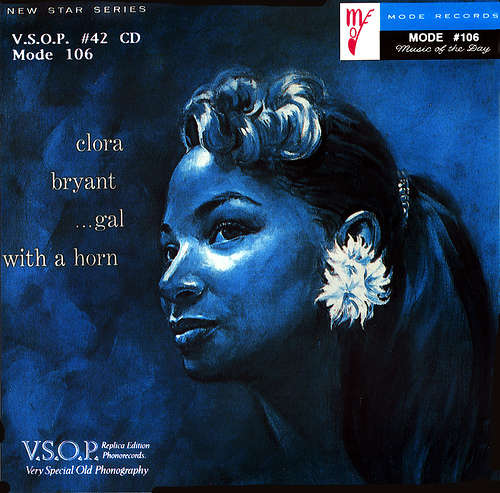
Strangely, in Dahl's interesting profile of Clora Bryant, one of the few sources of information on the singer/trumpeter currently available, no mention is made of Gal with a Horn (VSOP Records, 1995), a 1957 LP that Bryant cut for Mode Records and that constitutes the only entry in her CD discography to date. With a beautiful cover featuring a portrait of Bryant in black and blue, the album is a little too short at only eight tracks, "calculated to present Clora with tunes and setting that approximate her club performance," according to the original liner notes by Joe Quinn. Bryant sings and plays trumpet accompanied by Roger Fleming (piano), Ben Tucker (bass), and Bruz Freeman (drums), this quarter occasionally augmented by Walter Benton (tenor sax) and Normie Faye (trumpet). The program alternates between fast and slow numbers, all of them standards, showcasing the full range of Bryant's singing and playing and leaving ample room for solos.
The album kicks off with a swinging treatment of "Gypsy in My Soul" that allows her to play around with the melody for two full vocal choruses before closing her performance with an inventive, Gillespie-influenced solo. Her trumpet shines on a very relaxed reading of "Makin' Whoopee" graced by a very elegant piano solo by Fleming. This is followed by a lovely rendition of "Man with a Horn"("a natural for any trumpet playing entertainer," says Quinn) that Bryant makes entirely her own both vocally and instrumentally in one of the moodiest performances on the album. "Sweet Georgia Brown" is taken at a bouncy medium tempo that allows time for Bryant's trumpet plus a solo apiece from Benton and Fleming. The most unusual track on the LP is the Latin-flavored arrangement of Vincent Youmans's "Tea for Two" complete with a cha-cha-cha beat; it works because Bryant and everyone else involved are having a good time with it. Two tunes by Richard Rodgers and Lorenz Hart follow: Bryant reimagines the melody of "This Can't Be Love" ably aided by a lengthy piano solo by Fleming and then slows down the tempo for a wistful reading of "Little Girl Blue" that underscores the melancholy of the lyric and is embellished by a very soulful trumpet solo. Bryant again carries the weight of the group on the evergreen "S'posin'," which closes an excellent album that deserves to be better known from a very talented performer who deserves to be more than just a footnote in the history of jazz.