Showing posts with label Interviews. Show all posts

Saturday, May 23, 2020

A Conversation with Chuck Par-Due on Harry James

Oregon-based musician and author Chuck Par-Due has recently published Harry James—Trumpet Icon, a new biography of trumpeter Harry James that concentrates primarily on his music. With a foreword written by none other than Harry James, Jr., Par-Due's book celebrates the music of one of the most successful musicians to ever come out of the Big Band Era and should be a welcome addition to the shelves of a myriad swing and jazz enthusiasts. Not only is the author a devoted collector and follower of James' music, but he had the privilege of knowing the great trumpeter personally and draws on a great deal of interviews that he has conducted with musicians who knew or worked closely with James. The fact that Par-Due is himself a musician certainly helps when it comes to offering a musician's view on James' work, and as a result, the book addresses several questions that James aficionados have been asking themselves for decades.


Author / musician Chuck Par-Due
On the occasion of the publication of the book, I had the chance to speak at length with Chuck Par-Due for a new episode of the Jazz Flashes Podcast, and our 85-minute conversation covers many topics, including the book, James' life and career, the heyday and demise of the Big Band Era, James' relationship with other great names such as Benny Goodman and Frank Sinatra, and many more. If you are interested, you may access the entire episode of the podcast here below, and of course, I encourage everyone to check out the book, which is currently available from Amazon here.


Friday, January 15, 2016

Interview with Singer Bobby Rydell: "I grew up listening to the music of the big bands, and this music was in my blood from my childhood"

Our first post of 2016 is an interview we recently did with singer Bobby Rydell, in which he discusses his life and career, as well as two excellent early 1960s albums he made for the Cameo / Parkway label, mostly paying tribute to the music of the pre-rock era, which was more of an influence on his own style than one may think.

In the late 1950s and early '60s, between the first outburst of rock'n'roll and the arrival of the so-called British Invasion, the airwaves were suddenly filled with a gentler, sweeter kind of pop music, epitomized by teen idols such as Frankie Avalon, Ricky Nelson, and Fabian. One of the most popular among them was Philadelphia-born Bobby Rydell, whose memorable recordings of hits like "Kissin' Time," "Wild One," and "Swingin' School," among several others, turned him into a national sensation starting in 1959. After achieving great success on records and through appearances on top-rated television shows, Rydell made his movie debut in the now classic musical Bye Bye Birdie, alongside Ann-Margret and Dick Van Dyke, a role that did a great deal to further his career. Rydell has announced that in 2016 he will be publishing his autobiography and a pictorial of his career, and anyone interested in more information about this forthcoming book should check his website.


Rydell with Domenico Modugno
Despite the fact that, just like Bobby Darin, Rydell started out as a teen idol, he was steeped in big band music and pre-rock pop crooners (one of his hits was a cover of Italian crooner Domenico Modugno's "Volare," also cut by Dean Martin), and to this day his live act includes many tunes out of the Great American Songbook. In fact, in the 1960s he cut a few albums celebrating these influences, namely Bobby Salutes the Great Ones (1961), Rydell at the Copa (1961), and Bobby Rydell and the Bernie Lowe Orchestra Recreate the Big Band Days (1962). Back in October, these three LPs, along with a 1961 collaboration with label mate Chubby Checker, were reissued on a two-CD set by the British label Jasmine Records. As soon as we heard about this release, we got in touch with Mr. Rydell, through his assistant, Ms. Linda Hoffman, and he graciously agreed to an interview with The Vintage Bandstand to discuss his career in general and these albums in particular. We now present the full interview here.


Anton Garcia-Fernandez (for The Vintage Bandstand): You were born in Philadelphia. Please tell us a little bit about your childhood there. What kinds of music did you listen to? Who were your earliest musical influences?

Bobby Rydell: I grew up listening the music of the big bands.  My father used to take me to a theatre in Philadelphia that often showcased the legends of this era and I fell in love with the music at about age seven.  As a child I saw the incredible Gene Krupa live and it stayed with me until this day.  I remember telling my dad "That's what I want to be—a drummer."  Dad was responsible for everything I became.  He bought me my first set of drums and gave me drum lessons.  If the singing thing hadn't worked out, that's what I'd be doing today. 

TVB: Around 1950, you first appeared on the TV show Teen Club, which was hosted by legendary bandleader Paul Whiteman, and you stayed on that show for about three years. What do you remember about that show? Did you get to have much interaction with Mr. Whiteman?

Mr. Rydell: I was sort of the "mascot" on the Whiteman show. I was about eight years old when I won a talent contest and became a regular on the program.  I won a TV set (the first on our block!) in the contest for the show.  I don't remember a time that I wasn't performing.  Yes, Mr. Whiteman was very involved with the show—he was the person who first changed my name from Bobby Ridarelli to Bobby Rydell. He said no one would remember Ridarelli!

TVB: In the late 1950s, you signed a contract with the label Cameo / Parkway which led to big hits like "Kissin' Time," "Swingin' School," and "Wild One," among others, and which turned you into a very popular teen idol. How did that contract come about?

Mr. Rydell: I used to cut school to hang out at the studios (which were a two-by-four space, nothing major like you'd imagine).  I knew Bernie Lowe (one of the founders of the label) from the Whiteman show - he was a piano player on the show.  It wasn't until I met Frankie Day (my first manager) by chance at a show I was playing in one of my first bands - that I got an "audition" with the label - and the rest kind of just took off. 

TVB: On one of your albums for that label you were teamed up with another big star of the era, Chubby Checker. What do you remember about the sessions that produced that collaboration between the two of you?

Mr. Rydell: Being that we were both under contract with the same record label, they thought it would be a novel idea to have the both of us do a "duets" album to be released just before the holidays and toss in a couple of holiday songs.  One of those tunes, "Jingle Bell Rock," is really popular to this day on the radio stations during the holidays.  Chubby and I knew one another from the South Philadelphia area where we were both born and raised, and of course through the label and we had toured together in Australia a few times.  It was a natural type of recording session and a brilliant move by the label.  I think it became one of the top-selling albums for the label.  We still see one another on the road to this day.  We both still live in the same area of suburban Philadelphia. 

TVB: One of your most remarkable albums is Bobby Rydell Salutes the Great Ones, which includes rocking versions of standards such as "That Old Black Magic," "Wrap Your Troubles in Dreams," and "Nice Work If You Can Get It." What was the concept behind this LP and how did it come about? Did you select the songs? And if so, how did you select the songs?

Mr. Rydell: My manager and I selected the songs, submitted them to Cameo and they loved the idea.  This music was in my blood from my childhood and felt very natural that I record it - we did it with a touch of the contemporary and it worked.  When I started performing on shows like Red Skelton, Jack Benny, Perry Como  - this was the type of music they wanted me to perform on their shows - not the "Swingin' School," etc. 


TVB: In 1961 you first performed at the Copacabana, in New York, and the album Rydell at the Copa features a recording of your nightclub set there. How did the contract at the Copa come about? Your repertoire seems to be more adult-oriented. Did you get to choose your set lists for your engagement at the Copa?

Mr. Rydell: My manager, Frank Day, was the brains behind the Copa job.  He felt I was "ready" to graduate from the rock and roll shows onto the night club circuit.  He hired a stage coach for me, taught me dance steps, stage posture - even had a script written for the show with jokes, song medleys - it was a smash.  I got rave reviews by the tough New York critics calling the show a "powder keg of talent."  It was a thrill beyond belief for me. At age 19 I went down in history as the youngest performer ever to headline the famed Copa.

TVB: One can't help but notice that both Salutes the Great Ones and At the Copa feature several songs associated with Al Jolson ("My Mammy," "April Showers," "There's a Rainbow 'Round My Shoulder"). Was Jolson one of your musical influences? 

Mr. Rydell: No, Jolson wasn't really an influence.  

Rydell and Ann-Margret
TVB: One of your most memorable movie roles came in the 1963 film musical, Bye, Bye Birdie. How did you get involved in this movie? Are there any memories of co-stars Ann-Margret and Dick Van Dyke that you would like to share?

Mr. Rydell: Ann and I are friends to this day.  She calls and checks in often.  When she does she asks if "Hugo" is there.  We were 2 kids back then.  My original role of Hugo did not call for any singing (in the stage version) and only a few lines.  My audition with Ann was magnetic and the producers decided to expand Hugo's role. They thought we were magic together and wanted to play that up to the younger audience.  Every day we came to the set my role got bigger and bigger.

TVB: Finally, after all these years, you are still performing. For instance, you toured Australia last year. That shows that you must really enjoy music. Do you still listen to much music these days? And if so, what kinds of music and artists do you like listening to?

Mr. Rydell: My tour schedule today is full. [You can check it out here.]  I work frequently in a show called The Golden Boys, which is a production by Dick Fox, my present manager.  We have been performing this production  to sellout audiences for the past 30 years.  "The Golden Boys" are (officially) myself, Frankie Avalon, and Fabian.  When this first started we joked it would be good for about 6 months—never dreamt that people would still be buying tickets 30 years later.  The show features old film footage of our teen idol days, lots of production numbers with the three of us together, we individually do our separate shows, then come back together for a tribute to our fellow performers who have passed on.  There's even a dance contest.  I also do my solo show in Las Vegas and around the country, which is a mix of my oldies and lots of my favorite "standards" big band style.  Some of my shows (like one I'm doing at the Golden Nugget in Atlantic City) are with eighteen-piece orchestras and are songs from the American Songbook.


In 2012 I really thought it was over, though. I spent most of that year in and out of hospitals with tubes down my throat.  Never thought I'd sing again.  I needed a double organ transplant (kidney & liver).  Through skilled surgeons at Jefferson University Hospital in Philadelphia and my organ donor and the family who lost her, I am here today.  I'm still singing and telling my audiences the importance of becoming an organ donor.  They are able to come to the show because of one unselfish person. My donor's name was Julia, and she was in her twenties.

Of the artists today I'm especially fond of Diana Krall and Tower of Power.


Monday, November 16, 2015

Interview with Singer Nancy Harrow on New CD Reissue: "The Beatles' songs should be considered part of the standard jazz songbook."

Though, of course, whole albums of compositions by the Beatles had been recorded before by the likes of Count Basie (Basie's Beatle Bag, 1966) and Sarah Vaughan (Songs of the Beatles, 1981), to name but two, Nancy Harrow's The Beatles and Other Standards is one of the few records that offer a mixture of songs by the Liverpool lads along with standards written by some of the foremost tunesmiths who created what we now know as the Great American Songbook. This is, perhaps, the only album that includes both Paul McCartney's "Yesterday" and Otto Harbach and Jerome Kern's "Yesterdays," in an attempt to show that the jazz world can benefit as much from Tin Pan Alley as from the British Invasion. And, in a way, Harrow also helps prove something of which there is really very little doubt: that the songs the Beatles wrote and made popular in the 1960s are as timeless as those that Ned Washington, Victor Young, Johnny Mercer, and Vincent Youmans composed just a few decades before.


Harrow's collection of Songbook and Beatles standards was recorded in New York City in 1989 and originally released in Japan the following year. On the two sessions that were needed to complete the album, the vocalist was accompanied by a group of fine musicians led by pianist Sir Roland Hanna and including Bill Easley (saxophone, flute, and clarinet), George Mraz (bass), Grady Tate (drums), and Turkish-American percussionist Arto Tunçboyaciyan. Produced by John Snyder, this project evolved out of a close collaboration between Harrow and Hanna, who encouraged the singer every step of the way and acted as musical director. Harrow is obviously on her home turf with the standards, some of which ("My Foolish Heart," "More Than You Know") are beautiful vocal-piano duets with Hanna. The usually haunting "Nature Boy" benefits from a great flute introduction by Easley, and Harrow's cabaret-like approach to "When the World Was Young" is very appropriate and turns that track into one of the most memorable on the set.


Drummer Grady Tate
Adapting tunes by the Beatles to the jazz idiom is always a challenge, but Harrow more than rises to it throughout the album. Her version of "Drive My Car" is infectiously swinging (Easley and Hanna shine on saxophone and piano, respectively), and "Got to Get You Into My Life" is stripped of all its Motown overtones and turned into a ballad. Harrow reinvents "Yesterday" and "Something," emphasizing their torch-like qualities. They are both punctuated by Tate's drumming, and Tunçboyaciyan's persussion stands out on the former. "Blackbird" and "Because" are two of the most intimate performances on the album, and "Here Comes the Sun" is given a very appealing smooth-jazz treatment. Overall, this is a very artistically successful album that proves that a good song is good no matter who wrote it or when, as well as showing that a good jazz treatment of a Beatles song can be as satisfying as any tried-and-true jazz standard.

As soon as I heard of the reissue of The Beatles and Other Standards, I dropped Nancy Harrow a line, and she promptly and graciously responded, agreeing to an interview for The Vintage Bandstand. The following interview originated as part of our correspondence, and in it Harrow offers some interesting insights into the concept and the recording of this album.


Anton Garcia-Fernandez (for The Vintage Bandstand): How did you come up with the concept of a jazz album of Beatles songs and classic standards? What does the music of the Beatles have in common with the music of Johnny Mercer, Jerome Kern, and Vincent Youmans?

Nancy Harrow: I had recorded one Beatles tune before this album was done. It was on my Street of Dreams album that I did with Bob Brookmeyer, and the tune was "Fixing A Hole." It came out very well, and in fact that tune became part of my working repertoire.  So I began to listen to more of the Beatles tunes which I knew from my sons' record collection.  I liked their lyrics and the humor in a lot of the songs, and it occurred to me to pair the tunes with known standards to show that they should be considered part of the standard songbook that jazz musicians draw on.  At that time many jazz musicians were openly hostile to the Beatles' music, I think because they were putting them out of business. In any case, it was difficult to persuade musicians I knew to do an album like the one I envisioned.  But Roland Hanna was not judgmental about anything in music, and he agreed to do the album with me.

TVB: How did you select the songs for the album? Was it a difficult process?

Ms. Harrow: I selected the songs in the same way I always select songs.  I look for lyrics that are meaningful to me and for melodies that linger in the mind.

TVB: What aspects did you find challenging as you adapted these songs by Lennon, McCartney, and Harrison? Did you approach the standards and the Beatles tunes differently?

Ms. Harrow: The standards came more naturally to me, but the Beatles tunes were a challenge to sing in my own style rather than in theirs.  And this was made much easier for me because Roland was playing them.  The way we did them evolved during our rehearsal sessions.

Pianist Sir Roland Hanna
TVB: The album was cut in New York City in two sessions in May 1989. Jazz greats such as pianist Sir Roland Hanna, bassist George Mraz, and drummer Grady Tate were on hand for the date. What memories do you have of those sessions?

Ms. Harrow: I remember our rehearsal sessions even more than the recording session.  Roland was in a Broadway musical at the time, and we were rehearsing somewhere near the theatre because his time was limited.  I particularly remember his influence when we were rehearsing "Drive My Car," because we were both amused by the humor of this tune, and Roland suggested I say "and maybe I'll luhve you" -- not sure you can get this from my spelling, but you can hear it on the CD.  At the session, I remember Grady's suggestions about improvising on the lyric, which were helpful to me.  This was the first of many albums I did with both Roland and Grady together.  I also worked with Bill Easley and George Mraz on other projects, and did a club date with Arto Tunçboyacian afterwards. They are all great musicians, and I'm so glad this CD is now reaching audiences outside of Japan.

Bassist George Mraz
TVB: The album was originally released in 1990 by Emarcy for the Japanese market, where your work has always been very well received...

Ms. Harrow: John Snyder was the producer of this album, but it proved to be a difficult sell to record companies in the U.S.  I sent it to a record company in Japan who had released other CDs of mine, and they took it right away.  It turned out to be quite successful in Japan, and actually has had two releases there.  But no one until now has reissued it and distributed it worldwide.  I am so glad that Jordi Pujol [owner of Fresh Sound Records] has done that, because there are several songs on the CD that are among my favorite recordings.  I like the duets with Roland on "My Foolish Heart" and "More Than You Know" (Roland has a great solo on that tune), and I like "Drive My Car" and "When the World Was Young."  Roland's arrangement of "Yesterday" I think is terrific.  So I am very pleased it is finding a wider audience at last.

TVB: In your opinion, what is appealing to Japanese audiences about jazz? What is special to you about performing in Japan?

Ms. Harrow: The Japanese audiences are amazing.  I didn't actually perform there when this CD came out.  But in 2006, 2007, and 2008 I had club dates and a concert in Japan, and they did a Japanese version of my puppet show, Maya the Bee, which toured for two years in Japan.  The audiences there are so warm and welcoming -- it was a unique and wonderful experience to be there.

TVB: The European label Fresh Sound Records, of Barcelona, Spain, has shown interest in reissuing your work. A few years ago they released two of your 1960s albums, the excellent Wild Women Don't Have the Blues and You Never Know. Are there any plans for further releases in the near future?

Ms. Harrow: It was a surprise when Fresh Sound in Barcelona reissued my first two albums in one CD.  I didn't realize that in Europe the CDs become public domain after fifty years.  But it was such a pleasant surprise, because they did such a beautiful job on the CDs.  I just met Jordi Pujol a few weeks ago when I was in Barcelona.  We had only corresponded before that.  I am so happy to have found a new home for my early CDs, and now this Beatles album.  The next one they will release is The John Lewis Album for Nancy Harrow, which will be done very soon.  And there are plans ahead to do my Street of Dreams album as well, which has gone out of print.  So this is a very happy new relationship.

Further information

To read more about the reissue of The Beatles and Other Standards, you can go here. If you would like to purchase the CD, you will find it here. Fresh Sound Records also released two of Nancy Harrow's 1960s albums not long ago, and you can access my review of that reissue here. Finally, more information about Nancy Harrow is available on her homepage.


Nancy Harrow in the studio in the 1960s with John Lewis amd Jim Hall (photo originally published in JazzWax)

Monday, May 11, 2015

Interview with Wig Wiggins, Co-Author of New Bing Crosby Discography: "We spent several years preparing this new edition for publication."

Not only was Bing Crosby one of the most important vocalists of the twentieth century—he was also one of the most prolific, entering the studio repeatedly pretty much every year between his first known recording session in 1926 and his last in 1977. And yet, despite the sheer amount of his output, very few of Crosby's albums and single releases remain unavailable on CD, the proliferation of all kinds of reissues causing inevitable, and often irritating, duplication of titles. This makes a CD-specific discography necessary for the dedicated and casual Crosby fan alike, a fact that Frontis B. "Wig" Wiggins, of Arlington, Virginia, and his friend Jim Reilly, of Portsmouth, England, realized many years ago, when they published their book Bing Crosby's Commercial Recordings from 78s to CDs in 2001. Now, over a decade later, they have joined forces again to revise, update, and beautify that pioneering discography. The result, The Definitive Bing Crosby Discography from 78s to CDs, is a very attractive book that contains a wealth of information about Der Bingle's recording sessions with an eye to simplifying anyone's hunting for CD reissues of Crosby material from any period of his long, successful career.

The book is very well put together, carefully researched, and generously illustrated mostly with color pictures, and its intelligent organization, with all sorts of interesting indexes, makes it a joy to browse through. This is definitely not the kind of discography that only lists titles, dates, locations, backing orchestras, and catalog numbers; it also includes brief essays that discuss various aspects of Crosby's career, thus making the book appealing also to casual fans that may be interested in learning a little about each phase of Crosby's recorded legacy in addition to perusing a complete listing of masters, alternate takes, unreleased and non-commercial recordings, and even titles that contain studio errors, like his famous fluff on a rejected take of "Wrap Your Troubles in Dreams." The Vintage Bandstand has recently had the chance to interview Mr. Wiggins, who currently serves as the American and Canadian representative of the International Club Crosby, on the subject of the book, which is indispensable for both Crosby and popular music aficionados. As he mentions in the interview, a supplement to this discography, detailing all of Crosby's radio recordings that have been officially authorized for release on CD by Bing Crosby Enterprises, is in the works, and we are eagerly awaiting it. Before proceeding to the interview, we would like to express our most sincere gratitude to the authors for their wholehearted dedication to this project, which makes the lives of Crosby fans and collectors a great deal easier.

Bing Crosby with Frank Sinatra, and Judy Garland in the 1940s

Anton Garcia-Fernandez (for The Vintage Bandstand): When and how did the idea occur to you to begin such a daunting project as this Bing Crosby discography?

Mr. Wiggins: When the CD era began, I started annotating my personal discography each time a song title was reissued on CD to help organize my own collection. After a while my friend Jim Reilly, of England, and I decided it would be useful to publish a first version of a CD-oriented discography for others, which was entitled Bing Crosby's Commercial Recordings—From 78s to CDs. It was issued in 2001 and was very popular but has long been out of print. About four years ago we concluded that so many additional CD reissues had appeared that a revised and updated edition was desirable. We then spent at least three years exchanging telephone calls and e-mails to prepare this new edition for publication.

TVB: What was the rationale that you and Mr. Reilly followed as you began the project?

Mr. Wiggins: As there was no other current printed discography available that indicated which of Bing's recordings had been reissued on CD, and this was the manner by which most collectors were acquiring them, we thought a new edition of our original book would be appealing and useful to Crosby fans.

TVB: What is new and different about your discography when compared to other Crosby discographies available online and in book form?

Mr. Wiggins: The main differences are the following: (1) A listing of the original commercial release of each title on 78s, 45s, LPs, or CDs; (2) a listing of a recommended CD version of each title that has been released on CD; (3) a listing of the names of composers, orchestra leaders, and vocal accompanists; (4) the addition of sixty unnumbered illustration and information pages, most of them in color; (5) an exclusive new section entitled "Unreleased Studio Recordings"; and (6) multiple indexes to facilitate identification of entries and to make use easier.

TVB: This is an invaluable reference work for serious Crosby fans, but what is the appeal of the book for the more casual fan?

Mr. Wiggins: The addition of the sixty extra pages giving information about various aspects of Bing's overall career, including his films and radio broadcasts, for example, as well as lists of his "Gold Records," "Top Hits," and "Bing's Hollywood Songs," among other general information.

TVB: What aspects of this project were the most difficult to tackle for you and Mr. Reilly?

Mr. Wiggins: The creation and verification of the original commercial release of each song, wherever in the world. This new and unique feature was completed in consultation with other leading Crosby collectors over a number of years.

TVB: As you mentioned, the book is profusely illustrated with color pictures and contains some very interesting indexes and even lists of unreleased Crosby recordings and alternate takes. How many years did you and Mr. Reilly spend working on this project?

Mr. Wiggins: Jim Reilly and I have worked together since the early 1990s on recordings by Bing. For at least a decade I was consultant to MCA / Universal Music in Los Angeles, compiling and annotating Bing Crosby collections for reissue on CD, and Jim played the same role for the same company in London. This led to our three- to four-year project to publish our first discography in 2001, and then another three-year effort to update our new version.

TVB: What, if anything, have you left intentionally out of the book?

Mr. Wiggins: We decided it was best not to include Bing's extensive number of so-called "radio recordings," as this would have made the project too large and almost unending. As stated in the "Introduction" to this edition, we plan to produce a supplement to be entitled Special Radio Recordings. This will include all radio recordings authorized for release on CD by Bing Crosby Enterprises, such as the Mosaic CD box set of Bing's many songs recorded with Buddy Cole, along with other such compilations.

Louis Armstrong, Frank Sinatra, Peggy Lee, and Bing Crosby in the late 1950s

TVB: It seems that the book is selling rather well. What kind of responses have you received so far from Crosby collectors and fans?

Mr. Wiggins: Thus far, only telephone calls and brief notes of thanks praising the overall quality and content of our book have been received. Some have also expressed appreciation for the "Recommended CD" column, for helping to guide their collecting while avoiding excessive duplication. We have been disappointed, however, at the complete lack of any internet comments to date.

TVB: And finally, if you had to recommend three Bing Crosby releases to someone who is interested in getting acquainted with Crosby's phenomenal body of work, which ones would you choose? Thanks again to you and Mr. Reilly for your wonderful work on this new Crosby discography!

Mr. Wiggins: For the newer Crosby fan, or for one who is just starting out, I would recommend the following CDs: Bing's Gold Records (MCA / Universal MCAD-11719), Merry Christmas, which was retitled White Christmas (MCA / Universal MCAD-31143), and A Centennial Collection of Bing Crosby's Decca Recordings (MCA / Universal MCAD-88-113222). A single alternative to these would be the four-CD box set, Bing—His Legendary Years (MCA / Universal MCAD4-10887).

Further information

For more information about this new Bing Crosby discography (its price is US$35, postpaid via Priority Mail), as well as for ordering the book, you can contact Mr. Wiggins at the following mailing address: 5608 North 34th Street, Arlington, Virginia 22207, U.S.A. Mr. Wiggins will also take orders by phone (703-241-5608) and e-mail (wigbing2012 (at) gmail.com). The discography is also announced in the International Club Crosby website, where you can find information about how to order it if you live in the United Kingdom, Ireland, Australia, and New Zealand. If interested, please go here.


Tuesday, January 29, 2013

Interview with Philip Furia, Author of The Poets of Tin Pan Alley - Part 3 of 3

George and Ira Gershwin
The interview with Philip Furia, author of The Poets of Tin Pan Alley, among several other books on songwriters and songs from the Great American Songbook, comes to a close with this third and final part. On this occasion, Mr. Furia discusses the lyrics of Ira Gershwin, speculates as to why not many songs from the Golden Age of American songwriting are overtly political, and talks about the often difficult relationship between songwriters and Hollywood, as well as telling us a little about his many other projects. I would like to thank Mr. Furia for his dedication to researching the work of the great composers and lyricists, and also for the time and effort that he has put into this interview. I hope the readers enjoy this final part of our conversation, which was most interesting for me.

The Vintage Bandstand: In your very insightful chapter on Ira Gershwin, you observe that “what really interested him was less the romantic message than the medium of language itself—the vocabulary, idioms, and phrasing of American speech.” While I completely agree with that statement, it makes me wonder—isn’t that the case with every lyricist whose work you examine in your study? Or do you think that this concern with language is more obviously acute in the lyrics of Ira Gershwin?

Mr. Furia: Hmmm. This one made me really think. Let’s go back to an earlier question about the difference between poetry and lyrics. When we read a lyrical poem, such as Yeats’ “Easter 1916,” we assume that Yeats is writing about what he deeply feels about something that has happened to him. When Ira Gershwin writes “Someone to Watch Over Me” (1926), we don’t feel he is writing about his personal feelings or experience, however much he may share the lyric’s longing to be loved and protected. Songwriters of this era, like the troubadours of Provence, were ringing changes on a handful of romantic themes—falling in love at first sight, cataloging the beauties of their beloved, suffering the anguish of romantic rejection. Occasionally, a song such as the current hit, “Someone Like You,” may register the songwriter’s own personal romantic agony, but for the most part, particularly in the Golden Age, songwriters were understood to be crafting variations of a few romantic themes that had only remote resonance with their personal lives.

Yet in crafting those variations, some lyricists emphasized romantic passion, heartache, and euphoria in a wider variation more than did others. Hart, Berlin, Mercer, and Porter seem to me the lyricists with the greatest emotional “range,” from the ecstasy of “Wait Till You See Her” to “Nobody’s Heart”—to take two examples from some of Hart’s final songs in 1942, a year before his death. Other lyricists seem to treat romance playfully—but no less brilliantly. Here I’d place Ira Gershwin and Yip Harburg, who met in high school and remained lifelong friends. Ira wrote almost no lyrics of burning passion or wrenching romantic heartache until, late in his career, he wrote “The Man That Got Away” (1954) with Harold Arlen. Same with Yip Harburg, whose “Last Night When We Were Young” (1936, also with Arlen) was a rare but moving plunge into the depths. Both “Yip” and “Gersh,” as they nicknamed themselves in high school light verse, reveled in linguistic playfulness: Ira rhyming “You say ‘either,’ and I say ‘eye-ther'"; Yip twisting words in “I simply relish this swellish condish.” In such lyrics, it seems to me the linguistic play upstages the romantic passion.

TVB: The foremost lyricists of the golden age became masters at “saying ‘I love you’ in thirty-two bars,” to use your quotation from the biopic of Gus Kahn. However, as you point out in your book, many of them often depicted love in their songs from a markedly anti-romantic perspective. How do you explain this lyrical phenomenon?

Mr. Furia: Playing off my answer to the previous question, “saying ‘I love you’ in thirty-bars” meant finding new twists to the standard romantic themes of longing for love, falling in love, and losing love. A good lyricist always handled these standard situations with a clever twist, frequently a seemingly anti-romantic twist. Ira Gershwin describes a man’s reaction o his first passionate kiss with something we say when find our lover in bed with someone else: “How Long Has This Been Going On? (1928)” He and Yip Harburg wrote a song in 1934 called “What Can You Say in a Love Song (That Hasn’t Been Said Before)?” And what lyricists came up with was often unromantic, such as Larry Hart’s saying in “My Funny Valentine” (1937), “Your looks are laughable, unphotographable . . . “ or Cole Porter saying, “It’s the wrong time, it’s the wrong place, though your face is charming it’s the wrong face . . . but it’s all right with me” (1953). The best twist a lyricist could give to saying “I love you” was to say it unromantically

TVB: In your chapter on Howard Dietz and Yip Harburg, you note that Harburg was “deeply political.” We can clearly see that in his excellent lyric to “Brother, Can You Spare a Dime?” However, not too many lyrics from the golden age are overtly political. Why do you think that is the case, especially at a time when the United States were going through a harsh economic depression?

Mr. Furia: Another good question that I’ve thought about for years. You had political songs in the nineteenth century and certainly since the rise of rock and folk music in the 1950s and ‘60s, but very few in the Golden Age (Harburg’s “Brother, Can You Spare a Dime?” from 1932, always the exception that proves the rule). I think it goes back to the fact that most popular songs in this era came from Broadway and Hollywood musicals. With a few exceptions, such as “Ol’ Man River” from Show Boat (1927), these musicals were not overt political vehicles, and they called for frothy songs about love that suited their boy-meets-girl stories. I’m not a cultural historian, but my guess is that their apolitical nature also suited what radio stations wanted to play. The few musical films and shows that offered more political fare, such as Hallelujah! I’m a Bum (1933) and The Cradle Will Rock (1937), produced virtually no hit songs. While some songwriters, such as Woody Guthrie, were writing political protest songs, what most people listened to were the songs of Cole Porter and Irving Berlin, who even took heat in 1938 when he updated an old World War I song, “God Bless America,” for presuming, as a Jewish immigrant, to speak for America on the brink of World War II. Lyricists did much to look at depression tangentially in romantic lyrics such as Ira Gershwin’s “Things Are Looking Up” and “Nice Work If You Can Get It” (1937).


TVB: Though Irving Berlin, Cole Porter, the Gershwins, Rodgers & Hart, and Harry Warren, Al Dubin, and Mack Gordon graced movie musicals with some memorable songs, many composers and lyricists felt deeply constrained and unhappy in Hollywood. Why was the movie industry so reluctant to transpose Broadway musicals onto the screen? In retrospect, it seems that a good opportunity for the creation of great songs was wasted in most movie musicals whose plot revolved around the production of a musical. Don’t you think that the inherent metafictional nature of such films could have spawned some interesting songs on the subject of songwriting itself?
Al Dubin and Harry Warren
Mr. Furia: Songwriters who worked on Broadway musicals were at the center of the production from the outset and continued working with playwrights, directors, choreographers, and others through rehearsals and out-of-town tryouts, adding songs, altering songs, and doing everything they could to pull the show together. On opening night, their names were in lights on the theater marquee as “Rodgers & Hart’s Babes in Arms.”

When they went out to Hollywood after sound came to the movies, a very different system was in operation—one that pushed songwriters to the sidelines. They had little say in how their songs were used and sometimes only given the outline of a screenplay to work with. They were simply expected to “write hits” that would earn additional money for a film. “Out here,” composer Harry Warren observed of Tinseltown, “songwriters were the lowest form of animal life.”

As I said earlier, Hollywood at first worried that audiences would find it ludicrous if characters suddenly burst into expressive song then went back to dialogue. Therefore early movie musicals were “back-stagers” in which characters portrayed singers and dancers putting on a stage musical. When they sang, it was because they were rehearsing or performing a song before an on-screen audience. The songs they usually sang were the pop hits of the day. For example, when Jolson sang Irving Berlin’s “Blue Skies” in The Jazz Singer in 1927, the song had already been a big hit from the previous year.

Realizing that they would need lots of songs for such back-stagers, Hollywood studios bought out the catalogs of the old Tin Pan Alley sheet-music publishing firms and moved their composers, lyricists, and arrangers to the West Coast. Old songs could be recycled into new films and become money-making hits (which is what “As Time Goes By,” a song by Herman Hupfeld from 1931, did when it was inserted into Casablanca in 1942). When a studio did a film version of a Broadway musical, they frequently gutted all or most of its songs and had their in-house songwriters write new songs which the studio owned and could make money on. Occasionally, a song from a Broadway show was so well-known that the movie had to keep it (and pay for it). Cole Porter’s “Night and Day” was so famous that the musical it came from, The Gay Divorce (1932), was referred to as “The ‘Night and Day’ show.” When RKO did a film version of the show, they had to keep “Night and Day,” but they threw out all of Porter’s other songs and added new ones to the score. They also had to change the title of the show to The Gay Divorcée. It was 1934, the year the censorship “Code” came into force, and, while divorce could never be gay, a divorcée could since musicals had long before proved that even a widow could be merry.


To answer the last part of this question, a few of the early back-stager musicals did portray the creation of songs for a show, such as Lord Byron of Broadway (1930), but the films were generally so unimaginative that these opportunities were squandered. Even when Hollywood started making “biopics” about songwriters, such as Rhapsody in Blue (1945) and Night and Day (1946), the “inspiration” scenes for songs are frequently ludicrous. An exception is the scene where James Cagney, portraying George M. Cohan in Yankee Doodle Dandy (1942), writes “Mary’s a Grand Old Name.” Such songs still fall within the “performance” convention of presenting song in film. That convention, however, robs song of its expressive power. As I said earlier, when characters sing in opera, operetta, and stage musicals, they are not “performing” a song but, in the context of character and story, expressing what they feel at a heightened dramatic moment. That kind of expressive song only entered film in the early 1930s and largely disappeared by the 1960s. The few movies that tried to present songs expressively, such as At Long Last Love (1975), bombed with audiences, who had come to view characters in movies breaking into song as ludicrous. The only exceptions to that lost convention were cartoon musicals, musicals aimed at children, such as Mary Poppins (1964), and movies that were film adaptations of Broadway musicals. Only in these cases do contemporary movie audiences allow characters to sing expressively. In all other movies, a song must be presented as a performance—just as in the earliest days of film musicals.

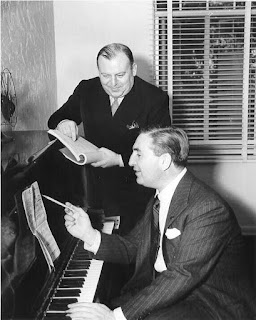
Hoagy Carmichael at the piano
TVB: In your book, you observe that songs that originated as jazz instrumentals seldom received lyrics worthy of note, Hoagy Carmichael’s “Star Dust” and Duke Ellington’s “Satin Doll” being among the notable exceptions. What is it, then, that makes jazz instrumentals particularly difficult to tackle for lyricists?

Mr. Furia: Since I’m not a lyricist, this is only speculation, but I imagine that there is virtually no collaboration between composer and lyricist when words are set to a jazz instrumental. Even though the music came first in other collaborations, composer and lyricist were usually in the same room together sweating out the lyric. The toughest thing for a lyricist, I imagine, is trying to hear what the music is “saying”—what latent emotional meaning lies in those abstract musical notes and phrases, rhythms and harmonies, that must be made articulate in words. There are several stories about the Gershwins, Dietz and Schwartz, and other collaborators in which the lyricist has asked the composer to slow a sprightly melody down to a languid ballad to suit the emotional contour of a lyrical idea. That kind of interplay usually didn’t happen when a lyricist added words to an existing jazz instrumental. With the great lyricists, of course, there sometimes didn’t need to be. In 1954, when Johnny Mercer heard Lionel Hampton and Sonny Burke’s “Midnight Sun” on his car radio as he drove along a California freeway, he was so taken with the instrumental that he pulled into a gas station, called the radio station on a pay phone (these were the days before cell phones), and asked them to play the song again. On just this second hearing, Mercer came up with a seamless, sensuous lyric, and he claimed the first thing that came to him were those opening feminine rhymes—“palace,” “chalice,” “aurora borealis.”

I suspect another problem is the lack of what Ira Gershwin called “particularity.” Jazz instrumentals were not written for a Broadway or Hollywood musical so there is no character or dramatic situation to help a lyricist come up with a new way to say “I love you.”

TVB: Besides The Poets of Tin Pan Alley, you have written whole books about Johnny Mercer, Irving Berlin, and Ira Gershwin. What was it about those lyricists that drew you to study their lives and careers more in depth? Are you currently planning or working on any further similar studies?

Mr. Furia: I wrote the book about Ira Gershwin right after The Poets of Tin Pan Alley. I wanted to look at one of those lyricists in depth, and Ira seemed a good choice. He’d had a fairly long collaboration with his brother but then wrote with a variety of other composers—Kern, Arlen, Weill—each with a very different musical style. He’d also worked with equal success on Broadway and in Hollywood. And he’d also written a lot about the art of lyric writing, especially in his wonderful anecdotes about his own songs, Lyrics on Several Occasions (1959). By sheer luck, the Gershwin family had just created an archive of the papers of the Gershwin brothers in Beverly Hills, so I got to be one of the first to work on that huge collection of manuscripts and other materials. Sheldon Meyer, my editor at Oxford, was enthusiastic when I proposed the idea for the book, so I could easily “get started.”

I had started working on another book for Oxford, about Hollywood lyricists, when another editor, from Simon & Schuster/Schirmer, approached me about doing a book for a series they were starting about popular song composers. I said I’d be interested but that it would have to be a composer who was also a lyricist. That pretty much meant Berlin or Porter, and I thought I’d be better able to follow Berlin’s music than Porter’s (though I still had to bring in a former music graduate student I’d taught at Minnesota, Graham Wood, to help me with the musical analyses). Berlin was also a good choice because his extensive manuscripts, scrapbooks of newspaper articles and interviews, and correspondence was just then being catalogued at the Library of Congress, so I was, again, one of the first to work on that collection. When I was writing The Poets of Tin Pan Alley, I was fortunate to be one of the few writers to receive permission to quote from Berlin’s song lyrics. Berlin was his own music publisher, so he owned the copyrights to his songs (unlike most other songwriters). He and his assistants were notorious for refusing—sometimes angrily so—to allow anyone to quote from his works. But his attorney read my chapter on his songs in The Poets of Tin Pan Alley and went to bat for me, so I was pretty sure I could get permission to quote from his songs. Finally, a colleague here at the University of North Carolina Wilmington turned out to be a friend of Mary Ellin Barrett, Berlin’s oldest daughter, and put me in touch with her. She is a writer herself and was enormously helpful.

The only downside to the Berlin book was that Sheldon Meyer, my editor at Oxford, felt betrayed that I had gone with another publisher and halted work on the book on Hollywood lyricists. We mended fence after the Ira Gershwin book did well, and the Gershwin family invited me and my wife to the big centenary celebration for Ira at Carnegie Hall, which Sheldon and his wife also attended.

Songwriter and singer Johnny Mercer
By this time I had already left Minnesota for North Carolina, and a natural subject for a book was Johnny Mercer, the only major lyricist of that era from the South. Savannah, his hometown, to which he returned frequently throughout his life, is only a few hours’ drive from Wilmington, so I could go there to interview friends and family members. I also interviewed people in California, New York, and other places, making this a true biography of Mercer rather than just a study of his songs (as my books on Ira Gershwin and Irving Berlin had been). Once again I had the good fortune to have access to Mercer’s papers, including a manuscript of an autobiography. His widow Ginger bequeathed all of this to Georgia State University in Atlanta, which set up a superb Mercer Archive.

Two years ago, after more than fifteen years of research, I completed the book on Hollywood lyricists, though by then it had expanded to include how songs were presented in all movies—not just musicals but dramatic films as well. My wife, Laurie Patterson, and I watched more than a thousand movies, many in film archives at UCLA, the Library of Congress, and the Wisconsin Film Archive. Our co-authored book, The Songs of Hollywood, came out in 2010 from Oxford University Press. Although Sheldon Meyer, by then retired, died before its publication, he knew it was finally coming out.

Right now I don’t have another book in progress but for the last couple of years I’ve been doing a series of short programs for our local public radio station. It’s called The Great American Song Book and each day I take one of the classic standards, talk about how it was written, why it’s so good, and tell an amusing or poignant story associated with the song. Then we play two versions of the song—a classic rendition by Sinatra, Ella, or another period singer, then a contemporary version by Rod Stewart, Willie Nelson, or the Supremes. I’ve been thinking about ways of turning these programs—now more than two hundred of them—into a book. If I do, I’m going to dedicate it to the memory of Sheldon Meyer.

Philip and his wife, Laurie (Photo: Jamie Moncrief)