Showing posts with label Bobby Hackett. Show all posts

Monday, September 15, 2014

Hugh Shannon, the Epitome of the Saloon Singer

In his live shows, Frank Sinatra always liked to present himself as a saloon singer, a performer of what is known as saloon songs—that is, tunes about love found and then lost or perhaps never found at all in the first place. These are sad, melancholy songs of self-pity to be sung to the accompaniment of a lone piano, usually set in a bar or a tavern, in those wee small hours of the morning, and often presented in the form of monologue, with the vocalist bending the ear of an imaginary bartender. Harold Arlen and Johnny Mercer's "One for My Baby (And One More for the Road)" and Matt Dennis and Earl Brent's "Angel Eyes" were Sinatra's saloon songs of choice, and he counted Tony Bennett and Dean Martin ("drunky Dean," as the Chairman would have it) as fellow saloon singers, and even though he never recorded a full album of classic saloon songs—Reprise's She Shot Me Down, from 1981, was the closest he ever got—this remained one of his favorite types of songs to sing throughout his career. Yet Sinatra's tally of saloon singers is grossly incomplete because he failed to mention Bobby Short and the man whose career we are discussing today—Hugh Shannon.

Billie Holiday encouraged Shannon to become a singer
Listening to Shannon, born in DeSoto, Missouri, into an Irish American family in 1921, one wonders just how much Tony Bennett was influenced by the smoky tone of his voice. Raised by his grandparents, Shannon became interested in the piano at an early age but did not become a professional singer until after World War II, when he supposedly decided to follow Billie Holiday's advice and began singing in clubs and bars around New York City, catering to the smart set and befriending the rich and famous. In a piece about him published in The New York Times in 1981, just a few months before his death, Shannon described the type of audiences for whom he played throughout his long career: 


We [he and Bobby Short] both deal with ladies and gentlemen. They're established. They have manners. They're attractive. And, for the most part, they're rich. They have good impulses for living and like living well. And the songs we sing are about people who like living well, not about the depraved or the deprived.


These words may go a long way to explain Shannon's reputation for being a snob (which, according to many friends and fans, he most definitely was not), yet they do accurately describe the crowds that flocked to his shows at New York nightspots such as Le Perroquet, the Cafe Carlyle, and the 22 Club, and bearing in mind his fondness for the songbooks of Cole Porter, Rodgers and Hart, Noël Coward, and Jerome Kern, among many others, they offer a truthful description of his repertoire as well. In that same New York Times article, Shannon also discusses his approach to performing: "I treat the room as a drawing room where I'm giving a party. It never occurs to me that I'm not the host. I watch the tables. I watch the drinks. I have to restrain myself not to seat people." And this intimacy was definitely an important part of Shannon's appeal, together with his penchant for witty humor, his sense of devil-may-care detachment when singing these songs, and the fact that he proved to be a walking encyclopedia of the Great American Songbook every time he sat at the piano. In this regard, he was to the Songbook what Leadbelly was to American folk music, and his art was appreciated by audiences both at home and overseas, where he occasionally performed at exclusive venues in places like France and Italy.

Regrettably, Shannon left us a rather meager recorded legacy, perhaps because he was best experienced live, and his art, like that of Noël Coward, did not translate so well to the medium of recordings. However, there are two Audiophile Records releases that anyone interested in Shannon's saloon singing should own. The most complete is a two-CD set entitled simply Saloon Singer that features Bobby Hackett on cornet on some of the tracks and that includes classics like "Everything Happens to Me," "Let's Do It (Let's Fall in Love)," "Down in the Depths of the 90th Floor," and the Jeri Southern-associated "You Better Go Now." Alongside this, the single CD True Blue Hugh offers sixteen tracks recorded in Lexington, South Carolina, in December of 1977, with Shannon alone at the piano, except for two tracks on which he is accompanied by Terry Lassiter on bass and Jim Lackey on drums. This album contains two songs closely associated with Shannon, "True Blue Lou" and "It's a Big, Wide, Wonderful World" (a minor hit for crooner Buddy Clark in the late '40s), along with other gems such as "A Hundred Years from Today," "Baltimore Oriole," "It Never Entered My Mind," "As Time Goes By," and a medley of "Just a Gigolo" and Cole Porter's "I'm a Gigolo." Shannon's passing in New York City in 1982, at age 61, deprived the world of one of the best saloon singers who ever lived, a man who not only defined that difficult art, but who lived and breathed it as well.

Sketch of Hugh Shannon that appears on the cover of the CD Saloon Singer

Thursday, November 17, 2011

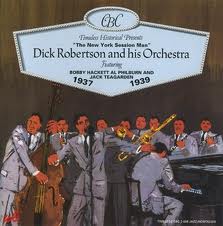
The Session Man in New York: Dick Robertson's Hot Vocal Jazz Recordings of the 1930s


Dick Robertson is one of a group of singers that are often overlooked in most critical discussions of the history of vocal jazz and that, when mentioned at all, are usually dismissed as second-rate practitioners of the art. And yet, a great deal of the numerous records that Dick Robertson made between the mid-1920s and the early 1940s belie such a quick dismissal. Will Friedwald briefly mentions Robertson in his excellent book Jazz Singing in the same breath with Smith Ballew, Scrappy Lambert, and Chick Bullock, stating that he “was the most vaudevillian of this group, and often alternated between different voices . . . to suit the material” (52-53). It is true that some of Robertson’s recordings are novelty numbers that remind us of vaudeville, but Friedwald’s description of Robertson fails to capture the essence of his art, which rests on his ability to front small groups made up of excellent jazz musicians who shine in their own right besides providing support for his versatile voice. This is precisely what we find in the only compilation of Dick Robertson’s recordings, entitled The New York Session Man (Timeless Records, 1992), which concentrates on sessions that the singer led between March 1937 and September 1939.


The title of this anthology is very appropriate. Dick Robertson was, indeed, a “session man,” a singer who gave up live performance for strictly studio work. Born in Canada, he had been singing professionally since the 1920s, mostly providing vocal refrains for various dance bands, when in 1935, Decca Records brought him into the studio to make a series of small-group jazz records. The company obviously trusted Robertson’s ear for choosing the best accompanists because they allowed him to handpick the lineup of his bands, and of course, his choices of sidemen do not disappoint, and his studio bands include some of the greatest jazz players of the 1920s and 1930s. On the twenty-four selections included in this compilation, we can hear the fabulous interplay between such illustrious names as cornetist Bobby Hackett, pianist Frank Signorelli (below, left), trombonist Al Philburn, guitarist Dave Barbour, drummer Stan King, and clarinetist Don Watt. Four sides waxed in February 1938 welcome the great Jack Teagarden on trombone into the studio group, and his hot playing enhances outstanding readings of tunes such as “Goodnight Angel” and “Let’s Sail to Dreamland.”


In accordance with the practice of the times, all of these sides range between a mid-tempo and an uptempo pace, and may be classified as primarily dance records. This is evident even in the case of numbers like “Gone with the Wind,” “Blossoms on Broadway,” and “I Only Want a Buddy, Not a Sweetheart,” which are usually treated as ballads but which are taken at a faster tempo by Robertson. The strong Dixieland feel of these discs must have sounded a little dated even when they were first released if we bear in mind that these platters hit the record stores coinciding with the advent of the Swing Era. However, they are recordings that have stood the test of time and that sound just as fresh now as when they were first made. And this is so not only because of Robertson’s knack for picking out magnificent sidemen but also because of his exciting vocal treatment of the lyrics. While it is true that novelty titles such as “The Merry-Go-Round Broke Down” and George Formby’s “Chinese Laundry Blues,” as Friedwald suggests, bring out the vaudevillian in Robertson, he manages to sound convincing when delivering more serious lyrics, as in the case of “It Looks Like Rain on Cherry Blossom Lane” and “Gone with the Wind,” to mention but two examples.

Another reason why a modern-day ear should still be interested in listening to these late-1930s recordings lies in the very engaging structure of the arrangements. Though Robertson is credited as the leader of the session, his voice is only another instrument and the vocal chorus that he performs is treated merely as yet another solo, which allows plenty of room for the sidemen to show off their talents. In this respect, Robertson’s Decca recordings are very similar to Billie Holiday’s classic Columbia sides with jazz greats like Lester Young and Teddy Wilson. Robertson’s studio bands sound relaxed and tightly knit, and the overall product leaves no doubt that the participants are having a good time trading inventive solos throughout.


A case in point is the lovely rendition of “Getting Some Fun out of Life,” a much-recorded number from the pen of Edgar Leslie and Joseph Burke. Frank Signorelli’s piano starts off the record with a few brief introductory bars, and then the whole ensemble states the melody, leaving a few more bars for Signorelli to put his signature on the tune before Robertson comes in with a very inspired vocal performance that swings easily while never straying a single note from the melody. After Robertson gets through singing the witty, well-constructed lyric, the remainder of the record is a pleasure to hear as Bobby Hackett (right), Johnny Carlson, and Don Watt trade hot solos, and, paraphrasing the lyric, the listener can bet they are getting some fun out of playing together.

As discographer Brian Rust observes in the liner notes to this compilation, Dick Robertson’s career as a recording artist came to an end following the infamous recording ban imposed by the American Musicians’ Union in 1942. By the time the ban ended, more than two years later, popular taste had shifted so much that there seemed to be no room for unabashedly hot jazz sides like these in the market, and as a result, Robertson did not make any more records. But fortunately, by the time he was forced into retirement, Robertson had already left behind an impressive body of work that shows that he deserves more credit than he receives these days. The twenty-four tracks on this Dutch compilation are ample proof of that and invariably leave the listener craving for more.

The great Jack Teagarden, whose hot trombone playing embellishes some of Dick Robertson's 1930s sides.

Works Cited

Friedwald, Will. Jazz Singing: America’s Great Voices from Bessie Smith to Bebop and Beyond. New York: Da Capo Press, 1996.

Rust, Brian. “Liner Notes to The New York Session Man 1937-1939.” Timeless Records, 1992.

Videos

WITHOUT THAT GAL (Posted on YouTube by edmundusrex)


NEVERTHELESS (Posted on YouTube by Bigband78)


IT’S THE TALK OF THE TOWN (Posted on YouTube by Bigband78)


I GOT RHYTHM (posted on YouTube by tmmvds)


HEY, YOUNG FELLA (Posted on YouTube by edmundusrex)


TWO CIGARETTES IN THE DARK (Posted on YouTube by MusicProf78)